Agentic AI Advisors in Banking and Insurance: from experimentation to core capability in 2026
Over the past decade, banks and insurance companies have invested heavily in automation and artificial intelligence to improve efficiency and customer experience. Yet most AI deployments to date—ranging from rule-based automation to chatbots and AI copilots—have largely remained supportive in nature. They analyze, recommend, or respond, but ultimate action and accountability still sit firmly with humans. As the industry moves into 2025–2026, a new paradigm is emerging that many financial institutions now view as decisive: Agentic AI Advisors.
Agentic AI Advisors represent not just a technical upgrade, but a structural shift in how organizations design processes, allocate responsibility, and operate at scale. This is the point at which AI moves from being a tool to becoming an actor within the enterprise—goal-driven, capable of taking action, and embedded into day-to-day operations of banks and insurers.
From responsive AI to action-oriented systems
The defining characteristic of Agentic AI Advisors is autonomy in action. Unlike chatbots that respond only when prompted, or copilots that require continuous human guidance, agentic AI systems are designed to pursue specific business objectives and to independently execute multi-step actions to achieve them.
In financial services, this distinction is critical. An agentic AI advisor does not merely suggest how to optimize cash flow; it can continuously monitor customer behavior, identify emerging liquidity risks, and adjust savings or payment schedules within predefined governance boundaries. In insurance, agentic AI extends beyond risk analysis to actively orchestrating workflows—triaging claims, prioritizing underwriting cases, requesting missing information, and generating near-real-time recommendations.
Equally important, agentic AI rarely operates as a single monolithic system. Instead, it is implemented as a network of specialized agents—each focused on data, risk, compliance, or customer interaction—that collaborate through shared context. This mirrors the functional structure of large financial institutions, but with significantly greater speed, consistency, and scalability.
Why agentic AI fits banking and insurance
Banking and insurance are among the most complex and tightly regulated industries. Decisions typically span multiple systems, datasets, and regulatory constraints. This complexity has historically limited the effectiveness of traditional automation and made large-scale human-driven operations costly and slow. Agentic AI directly addresses this gap.
Many core processes in financial services are multi-step, repetitive, and context-dependent. These processes are poorly suited to static automation but ideal for agentic systems capable of reasoning and acting across steps. At the same time, cost pressures continue to rise, while regulatory scrutiny intensifies. Agentic AI offers a way to increase operational throughput without sacrificing control, provided it is deployed within a robust governance framework.
Customer expectations also play a decisive role. Financial services are increasingly expected to operate in the background of daily life. Customers do not want to manage transactions actively; they want outcomes to be optimized automatically. Delivering this “invisible” experience requires AI systems that can act on behalf of customers, not simply advise them.
Implementation as an organizational challenge
A common misconception is that deploying agentic AI is primarily a model or data problem. In practice, the largest barriers are organizational and architectural. Successful institutions approach agentic AI as a process redesign initiative rather than a technology add-on.
Agent-native process design
Rather than digitizing workflows originally built for humans, leading organizations redefine desired outcomes and decompose work in ways that align with AI strengths. This often results in shorter decision chains, fewer manual handoffs, and more real-time execution, while still preserving clearly defined control points for risk oversight.
Data foundations and enterprise context
Agentic AI requires not only accurate and timely data, but data with clear semantics. This has driven increased adoption of knowledge graph architectures, enabling AI systems to understand relationships among customers, products, risks, and regulations. Such contextual understanding is essential for explainability, auditability, and regulatory confidence.
Technology architecture for action
On the technology side, agentic AI depends on modular, microservices-based architectures. Agents must be able to interact securely with enterprise systems, APIs, and tools in production environments. Standardized mechanisms for sharing context between models, data, and tools are becoming foundational to scaling agentic AI beyond isolated pilots.
Managing AI as a workforce
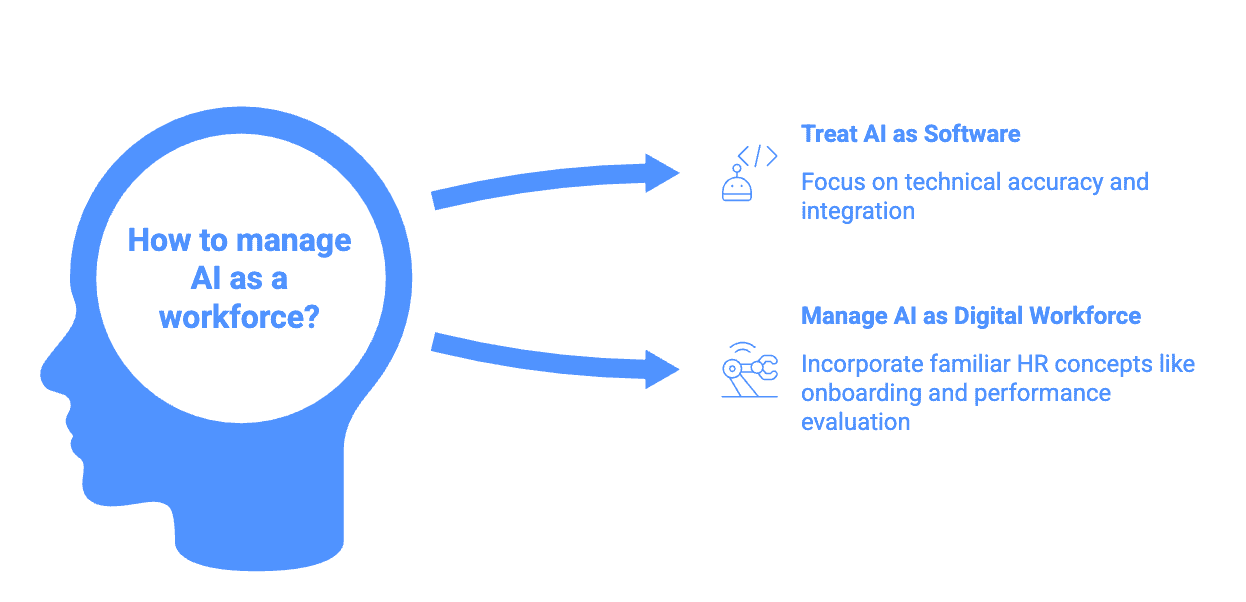
Perhaps the most profound shift associated with agentic AI is how organizations manage it. Rather than treating agentic systems as software components, forward-looking institutions manage them as a form of digital workforce.
This perspective introduces familiar concepts such as onboarding, access control, performance evaluation, and accountability. Agentic AI systems are assessed not only on technical accuracy, but on business impact—cost reduction, cycle-time improvement, compliance outcomes, and customer satisfaction.
Human roles evolve accordingly. Instead of performing routine decision-making, professionals increasingly act as supervisors of agentic systems. They intervene in edge cases, oversee high-risk decisions, and remain accountable for ethical and regulatory judgments that AI cannot autonomously resolve. In this model, human-in-the-loop oversight becomes a stabilizing mechanism rather than an operational bottleneck.
Looking ahead to 2026
By 2026, Agentic AI Advisors are expected to move decisively from experimental initiatives to core operational capabilities. The focus shifts from demonstrating technical feasibility to delivering measurable return on investment.
In retail banking and wealth management, agentic advisors enable large-scale personalization, extending sophisticated financial guidance beyond high-net-worth clients to mass-affluent segments. In insurance, AI-driven underwriting and claims command centers dramatically reduce processing times while improving consistency and transparency.
At the organizational level, the rise of small, human-led teams supported by multiple specialized AI agents reshapes how products are built and delivered. This model accelerates innovation while containing costs, particularly in technology and operations functions.
Conclusion
Agentic AI Advisors signal a maturation of artificial intelligence in banking and insurance. They mark the transition from passive support systems to active participants in enterprise operations. For many institutions, 2026 will be a defining moment: those that successfully integrate agentic AI into their processes, data, and governance structures will establish durable advantages, while others risk falling behind.
The strategic question is no longer whether to adopt agentic AI, but whether organizations are prepared to redesign how work is done so that AI can operate as a responsible, accountable actor within the financial enterprise.
Contact Us
Connect with sourceCode
If you found this message inspiring and wish to stay updated with our expert insights, be sure to Follow sourceCode on LinkedIn today!
Additionally, if you are interested in strategic partnerships, innovative technology solutions, or exciting career opportunities, don't hesitate to visit our official website: sourcecode.com.au