The Underwriting Capacity Problem No AI Roadmap Accounts For
sourceCode | BFSI Technology Insight | 9 October 2026
Key Takeaways
-
U.S. Bureau of Labor Statistics data shows the actuarial profession is a small, slow-growing pool (31,200 employed in 2025, ~9% growth to 2035, only ~1,500 openings a year) - while the underwriter workforce itself is projected to shrink 4% over the same decade as automation absorbs routine work (BLS, 2026).
-
RSM's 2023 workforce analysis forecast the U.S. insurance industry would lose roughly 400,000 workers to attrition by 2026 - the year this article is being published. That forecast horizon has now arrived, and the departures are disproportionately experienced staff, not entry-level hires (RSM, 2023).
-
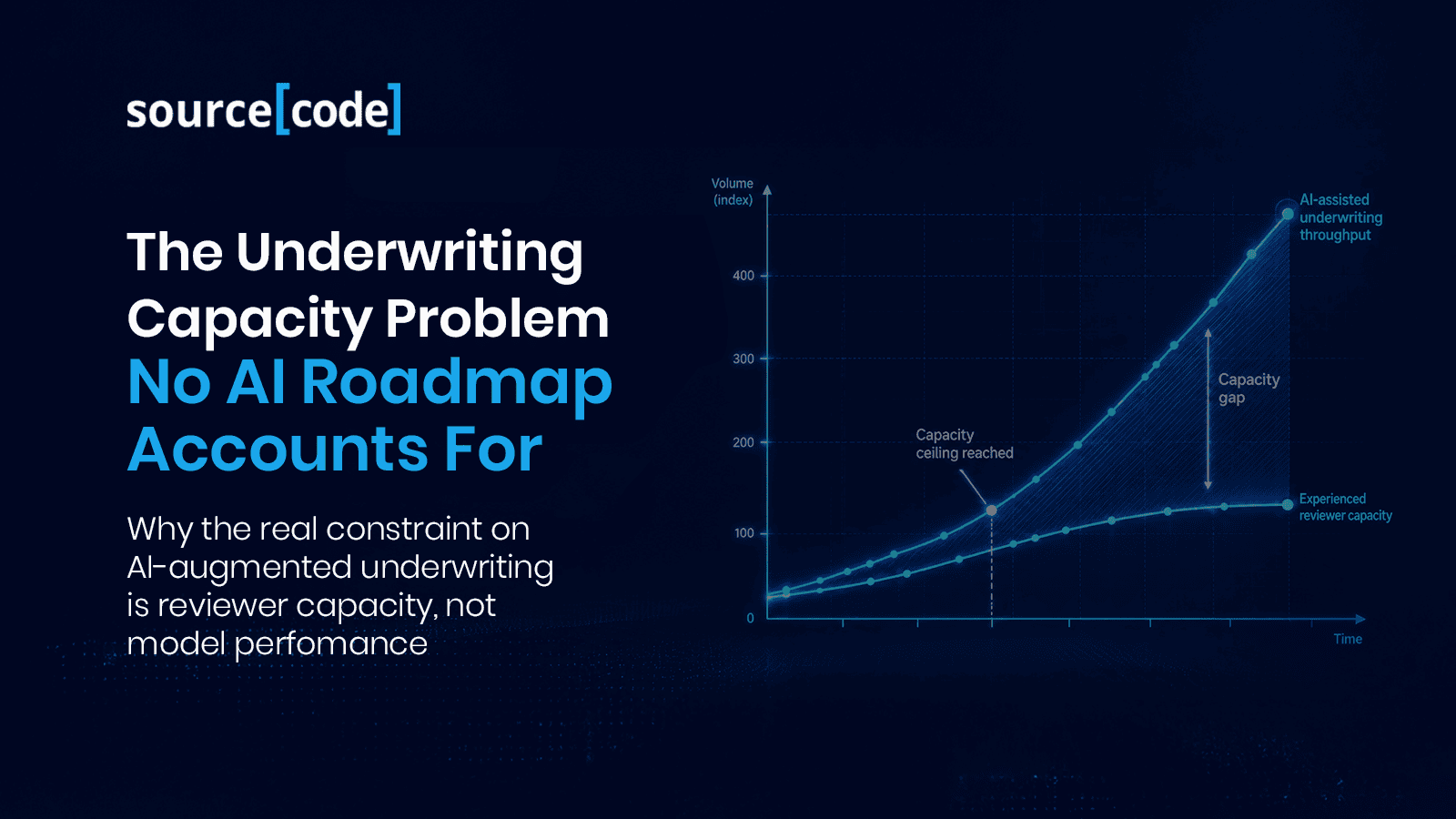
Most underwriting AI roadmaps size model performance (accuracy, loss-ratio lift, cycle-time reduction) but never size the one resource that determines whether any of it can be trusted: senior reviewer hours available to validate what the model produces.
-
AI does not remove the need for experienced judgment - it concentrates it. Automation clears the easy 70-80% of cases, which pushes the harder, more ambiguous, higher-stakes decisions toward the smallest, most experienced segment of the underwriting bench.
-
APAC and Gulf insurers should not assume this is a U.S.-only problem, nor assume it transfers unchanged. Regional actuarial hiring commentary (Actuaries Institute Australia, 2026) shows a structurally tight, geographically concentrated talent pool with its own dynamics - reasoned about explicitly below, not extrapolated from U.S. numbers.
Introduction
Every underwriting AI business case in front of a Chief Underwriting Officer this year makes the same promise: more risks assessed per underwriter, faster time-to-quote, lower loss ratios through better risk selection. Almost none of them ask a second question that determines whether the first promise is deliverable - who, exactly, is going to check the model's work, and how much of their time is actually available to do it.
This has been treated as an HR problem. Recruitment teams get a mandate to hire more underwriters and actuaries; L&D gets a mandate to upskill existing staff on the new tools; and the AI roadmap proceeds on the assumption that reviewer capacity is elastic - that if leadership wants more oversight hours, more oversight hours will show up. The workforce data does not support that assumption. The population of people qualified to supervise, override, and validate underwriting model output is small, slow to grow, unevenly distributed geographically, and - in the underwriting occupation specifically - currently shrinking in raw headcount even as the actuarial specialism needed to steward AI models barely keeps pace with attrition.
This piece follows on from two things we have argued before: that AI-augmented underwriting needs a Second Number - a validated measure of what "good" looks like beyond the model's own confidence score - and that organizational Capability is a compass, not a checkbox. Workforce capacity is where both of those ideas meet reality. A roadmap can specify exactly how model output should be checked and still fail, quietly, if there are not enough qualified people with enough uncommitted hours to do the checking.
The workforce evidence: what we can actually verify
Start with the U.S. data, because it is the most complete and the most current we could independently verify, and because U.S. carriers, reinsurers and consultancies are the reference point most APAC and Gulf underwriting AI vendors build against.
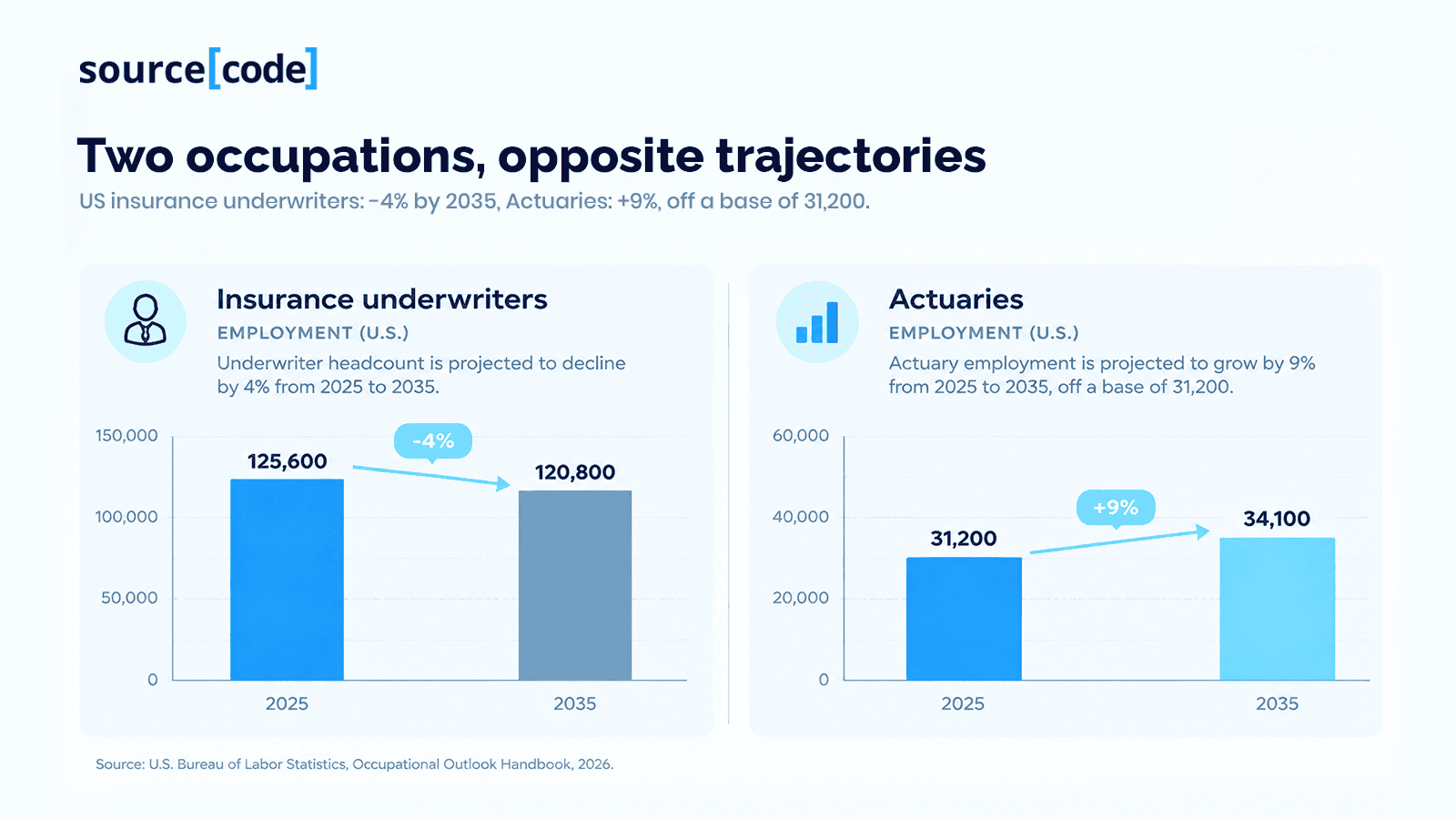
The U.S. Bureau of Labor Statistics' Occupational Outlook Handbook shows 31,200 people employed as actuaries in 2025, with employment projected to grow 9% from 2025 to 2035 - "much faster than average" for all occupations, but off a small base. That growth adds roughly 2,900 net new positions over the decade, with about 1,500 total openings projected per year on average (most of those replacing people who leave the occupation, not net new seats) (BLS, 2026). Median pay sits at $130,000 a year, itself a signal of a tight, competed-for labour pool.
Set that against the occupation actually doing the underwriting: the BLS projects insurance underwriter employment to decline 4% from 2025 to 2035, a net loss of about 4,800 jobs from a 2025 base of 125,600, driven explicitly by "automated underwriting software" reducing the need for underwriters to process routine applications. Notably, even as headcount shrinks, the BLS still projects roughly 6,800 openings a year in the occupation - almost entirely replacement demand from people leaving the field or retiring (BLS, 2026). That combination - falling headcount, high replacement churn - is the profile of an occupation that is contracting from the bottom while losing experience from the top, at the same time.
RSM's 2023 industry analysis put a number on the broader attrition wave: it forecast the U.S. insurance industry would lose around 400,000 workers to attrition by 2026, and separately noted that over half of insurance providers were already hiring specifically for data analytics skills - evidence that the industry knew the kind of person it needed to replace outgoing staff with was changing, not just the number (RSM, 2023). We are now in the year that forecast pointed to. Worth being precise about what this figure is and isn't: it is an industry-wide attrition estimate (retirements, resignations, role changes across all insurance occupations), not an actuarial- or underwriting-specific count, and RSM's own article does not name the original methodology behind the 400,000 figure in the text we could access. We treat it as directionally credible industry commentary from a named, credible source, not as a precise, auditable count - and we flag that distinction rather than smoothing over it.
DW Simpson's 2026 recruiting commentary, while largely qualitative rather than statistical, corroborates the shape of the problem from the demand side: it describes "the ongoing actuarial talent shortage" as an established market condition, notes the pipeline of new entrants "remains relatively limited" relative to demand, and - in a separate mid-2026 piece - observes that critical actuarial roles "often remain open longer than expected" as the market has become more specialized by line of business (DW Simpson, 2026a; DW Simpson, 2026b). Specialization matters here: a shortage of actuaries in aggregate is a smaller problem than a shortage of actuaries with the specific P&C, health, or specialty-line depth a given underwriting model needs validated.
On geography: this is where discipline matters. The BLS and RSM data above are U.S.-specific, and we have not found a directly comparable, publicly available quantitative dataset for Australia, the UK, or the Gulf that would let us make an equivalent numeric claim for sourceCode's core APAC and Gulf markets - we looked, and we are saying so plainly rather than presenting U.S. figures as if they were regional ones. The closest regional primary source we could verify is the Actuaries Institute Australia's own 2026 commentary on the Asia actuarial job market, which describes hiring as "quieter compared to the peak" of 2021-2023 but still tight, with Hong Kong and Singapore remaining the dominant actuarial hubs and strong emerging demand in Vietnam, Thailand, Malaysia and India as insurers there build out capacity - markets with thinner existing actuarial density than the hubs they are hiring from (Actuaries Institute Australia, 2026). The same source is candid that AI "hasn't necessarily been a game changer for actuarial just yet," and frames the near-term challenge as embedding AI into workflows rather than replacing the judgment those workflows depend on.
Our reasoning, not a borrowed statistic: APAC and Gulf underwriting functions draw heavily on internationally mobile, internationally qualified actuarial and underwriting talent - UK, Indian, South African, Australian and U.S. credentials all circulate through these markets via mutual recognition and expatriate hiring. A tightening in any one of those source markets does not stay contained to it. A CUO in Sydney, Dubai or Singapore competing for the same globally mobile senior actuarial talent as a U.S. or UK insurer is exposed to that market's scarcity even without a local shortage statistic to point to. That is a reasoned inference, not a verified regional figure, and we present it as such.
Why this is structural, not cyclical
Three mechanics compound here, and none of them resolve on a normal hiring-cycle timeline.
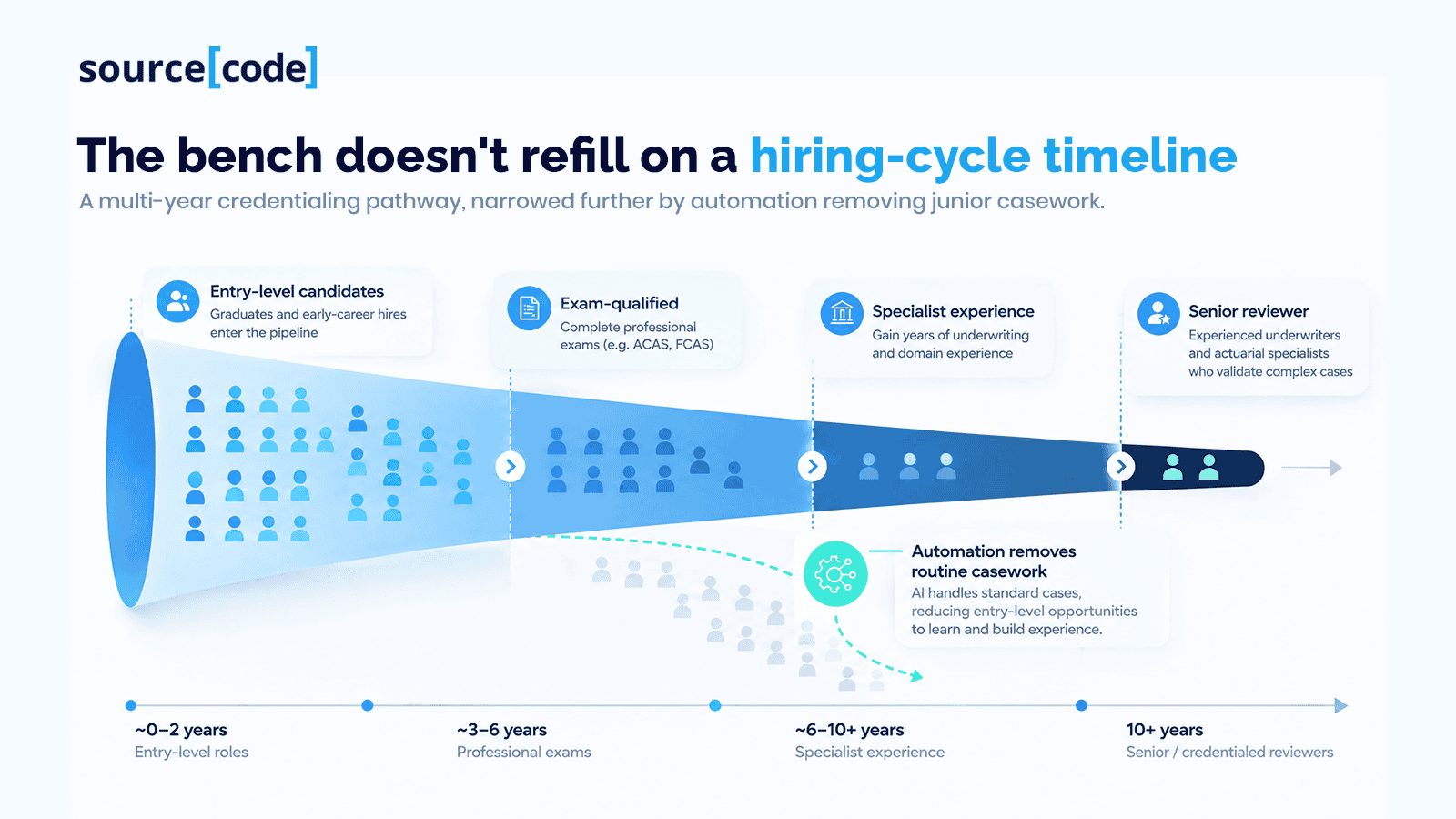
First, the credentialing pathway into senior actuarial and underwriting judgment is long by design. Professional bodies build in a multi-year sequence of examinations, mentored casework and rotational experience precisely because the judgment being certified - how to price and select risk in ambiguous, non-textbook situations - cannot be verified any faster. You cannot compress the pipeline that produces reviewers by putting more budget into recruitment marketing; the constraint is time-in-seat under supervision, not applicant volume.
Second, automation is thinning the very rung of the ladder that has historically produced tomorrow's senior reviewers. The BLS underwriter decline is concentrated in the routine, high-volume work that used to be where junior underwriters built the pattern-recognition that eventually made them capable of overriding a model. If AI absorbs that formative caseload before junior staff have been through enough of it to develop judgment, the pipeline that refills the senior bench thins from below at the same time attrition thins it from above.
Third, specialization is narrowing the usable pool faster than the aggregate pool is shrinking. A generalist actuary or underwriter is not a substitute validator for a model trained on, say, cyber liability or parametric climate risk. As underwriting AI gets deployed line-by-line, the relevant capacity constraint is not "how many actuaries exist" but "how many actuaries with this specific book's depth exist and have spare hours" - a much smaller and less fungible number than the headline workforce statistics suggest.
What most underwriting AI roadmaps get wrong
The pattern we see across underwriting AI programs is consistent: the roadmap is built around model metrics - accuracy against a holdout set, loss-ratio improvement, cycle-time reduction, straight-through-processing rate - and human review is scoped as a governance checkbox ("human-in-the-loop will be maintained for all decisions above $X exposure") rather than as a resourced, budgeted capacity with its own throughput limit.
This misses a counterintuitive effect: increasing automation does not straightforwardly reduce the volume of cases requiring expert human judgment - it can increase it, in absolute terms, even as it reduces it as a share of total volume. If an AI underwriting system expands the population of risks the business is willing to quote (because triage is faster and cheaper), and it correctly routes the easy majority through straight-through processing, the residual flagged for human review is smaller as a percentage but can be larger in absolute case count than what the same underwriters were reviewing manually before - and it is systematically the harder, more ambiguous, more adversarial subset, which is more expensive per case to review properly, not less. A roadmap that tracks "percentage automated" as its headline success metric can hit its target while quietly overloading the exact people the design was supposed to relieve.
Business and technology implications
For a CUO or Head of Underwriting evaluating an AI program, this reframes several decisions:
- Reviewer capacity becomes a sizing input, not a governance afterthought. Before setting an automation-rate target, the program needs an honest count of qualified reviewer hours available per week for the specific lines the model touches - not headcount, hours, net of existing caseload and non-review duties.
- Architecture choices should be judged partly on how much senior time they consume per decision. A model that produces a bare confidence score forces a reviewer to redo much of the analytical work from scratch. A model that produces structured, auditable reasoning - what it weighted, what it flagged as anomalous, what comparable cases it drew on - lets an experienced reviewer validate in minutes what would otherwise take much longer. This is a design decision engineering teams make early, and it directly determines how far scarce reviewer hours stretch.
- Triage design should protect senior time, not just maximize automation. Routing logic should be explicitly tuned to reserve the smallest, most experienced segment of the bench for the cases that need it, rather than treating every model-uncertain case as equally deserving of the most senior available reviewer.
- Workforce and L&D planning are now technology delivery inputs. A credentialing pipeline that takes years to produce a capable reviewer needs to be forecast against the AI roadmap's rollout schedule, in the same planning cycle - not handed to HR as a parallel, disconnected workstream.
A decision framework: The Validator Ceiling
To make this operational rather than aspirational, we use a simple framework with underwriting AI clients: The Validator Ceiling - the maximum sustainable rate of AI-assisted underwriting decisions an organization can responsibly process, given three inputs.
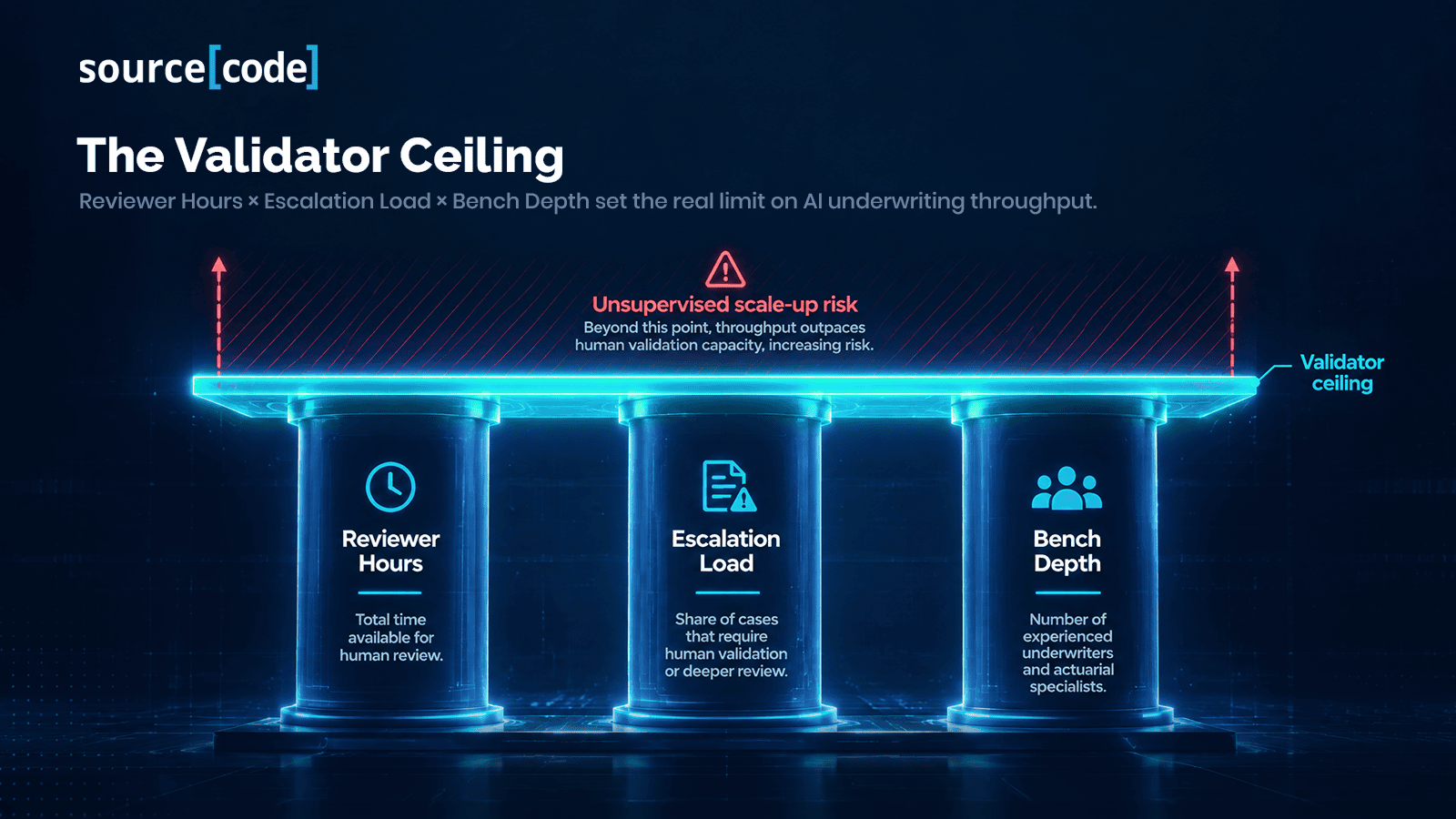
1. Reviewer Hours - the actual number of qualified senior underwriting/actuarial hours available per week for a given line, net of existing caseload, management duties and leave - not the headcount figure used in workforce planning decks.
2. Escalation Load - the realistic number of AI-flagged or ambiguous cases per week that will require that level of judgment, based on the model's actual precision/recall in production and the complexity profile of the book, not the vendor's benchmark accuracy figure.
3. Bench Depth - how many people are currently in the credentialing or specialization pipeline behind today's senior reviewers, and how many years out they are from being able to validate independently on this specific line.
The Validator Ceiling is reached when Escalation Load approaches Reviewer Hours with no Bench Depth arriving in time to relieve it. Past that point, an underwriting AI program has two honest choices: slow the automation rollout to match reviewer capacity, or accept that oversight quality will degrade in ways that will not show up until a loss event or a regulatory review surfaces it. Every roadmap we would consider credible computes this ceiling before setting a deployment target, not after a capacity problem appears in attrition or error-rate data.
Counterargument and nuance
The strongest objection to this thesis is that AI underwriting will eventually reduce reliance on experienced human judgment altogether, making the reviewer-capacity constraint temporary. There is a real, narrower version of this that is already true: for simple, low-complexity, high-volume lines - small commercial, straightforward personal lines - automation is legitimately reducing the need for underwriter involvement, which is exactly the trend the BLS decline figure captures. That is a genuine, durable shift, not a capacity problem to be solved.
But it does not generalize to complex, specialty or high-severity lines, for two reasons. First, regulatory expectations around model risk management and conduct obligations - increasingly explicit across UK, EU, Australian and Gulf regulatory frameworks - require demonstrable human accountability for material underwriting decisions, not just statistical performance. Second, AI models systematically underperform precisely on the tail risks and novel exposures that underwriting exists to price - the cases where historical data is thin and judgment matters most. Removing expert oversight there does not eliminate the risk; it defers it to the point of loss.
It is also fair to note that some insurers are mitigating the constraint rather than accepting it: expanding offshore actuarial hubs, using overseas qualification reciprocity to source senior reviewers from tighter markets, and restructuring roles so experienced staff spend a higher proportion of their time on judgment rather than administration. These are legitimate responses that a pure "shortage" framing can understate - the constraint is real, but it is also, to a meaningful degree, a design choice about how existing senior time is spent.
The sourceCode perspective
In nearly every underwriting AI engagement we've been part of, the conversation starts with model performance and ends, months later, with a capacity conversation nobody scoped time for. That's a sequencing failure, not a workforce failure.
The technology delivery discipline that actually holds up in production is one where reviewer capacity is sized as a non-functional requirement before the model architecture is finalized - alongside latency, availability and data quality - and where the platform is deliberately engineered to make each hour of senior underwriting judgment do more: structured explainability instead of a raw score, triage that routes by genuine complexity instead of blanket thresholds, and audit trails that let a reviewer validate a decision without re-deriving it from scratch.
None of that is exotic engineering. It is simply treating the scarcest resource in the system as an engineering constraint, not an HR line item to be solved later.
Conclusion
The binding constraint on how fast AI-augmented underwriting can scale, for anything beyond the simplest lines, is not model accuracy or infrastructure - it is the number of experienced people available to tell the model when it's wrong, and how much of their time that actually requires. That population is small, slow to grow by design, unevenly distributed globally, and being thinned from below by the same automation trend meant to reduce reliance on it. Treating that as an HR problem to solve in parallel misreads the situation. It is a design input, due at the same table as the model architecture decision, not after it. A CUO who has not computed their organization's Validator Ceiling has not finished scoping their AI roadmap - they've scoped half of it.
If you're mid-roadmap and haven't sized reviewer capacity against your automation targets, that's worth a direct conversation before the next deployment milestone, not after it. Talk to us here!
FAQ
Is the actuarial and underwriting talent shortage global, or mostly a U.S. phenomenon? The hardest, most current quantitative evidence we could verify (BLS, RSM) is U.S.-specific. Regional commentary from the Actuaries Institute Australia (2026) confirms a structurally tight, hub-concentrated APAC market with its own dynamics, but we did not find an equivalent regional dataset - treat the U.S. figures as directionally informative for globally mobile talent pools, not as APAC or Gulf statistics.
Does more AI automation reduce the need for experienced underwriters? For simple, high-volume, low-complexity lines, yes - and that is already reflected in BLS's projected 4% decline in underwriter headcount to 2035. For complex and specialty lines, automation tends to concentrate demand for experienced judgment on the hardest cases rather than eliminate it.
What is "reviewer capacity" in the context of an AI underwriting roadmap? It is the actual number of qualified senior hours per week available to validate, override or sign off on AI-assisted underwriting decisions for a specific line of business - net of existing caseload - as distinct from headcount or organizational chart figures.
How does the Validator Ceiling framework work in practice? It compares Reviewer Hours (available qualified capacity), Escalation Load (realistic volume of cases needing human judgment given actual model performance) and Bench Depth (how many future reviewers are in the pipeline and when they'll be ready) to establish the maximum sustainable rate of AI-assisted underwriting a business can respectably run.
Where should a CUO start if they haven't sized this yet? Start with an honest audit of current senior reviewer hours against current caseload - before adding any AI-driven volume - then model how the AI program's expected escalation rate changes that picture over the next 12-24 months.
Full Reference List
RSM US (2023) Skills gap in insurance industry's aging workforce is a growing concern. Available at: https://rsmus.com/insights/industries/insurance/skills-gap-in-insurance-industrys-aging-workforce-is-a-growing-concern.html (Accessed: 9 October 2026).
U.S. Bureau of Labor Statistics (2026) Actuaries, Occupational Outlook Handbook. Available at: https://www.bls.gov/ooh/math/actuaries.htm (Accessed: 9 October 2026).
U.S. Bureau of Labor Statistics (2026) Insurance Underwriters, Occupational Outlook Handbook. Available at: https://www.bls.gov/ooh/business-and-financial/insurance-underwriters.htm (Accessed: 9 October 2026).
DW Simpson (2026a) Actuarial Hiring Challenges & Talent Shortage Risks. Available at: https://www.dwsimpson.com/2026/03/17/actuarial-hiring-challenges-talent-shortage/ (Accessed: 9 October 2026).
DW Simpson (2026b) What Employers Should Know About Today's Actuarial Talent Market. Available at: https://www.dwsimpson.com/2026/07/22/actuarial-talent-market-trends/ (Accessed: 9 October 2026).
Actuaries Institute Australia (2026) The Asia actuarial job market in 2026: What recruiters are seeing, Actuaries Digital. Available at: https://www.actuaries.asn.au/research-analysis/the-asia-actuarial-job-market-in-2026-what-recruiters-are-seeing (Accessed: 9 October 2026).