What Underwriting Loses When It Optimises Only for Speed
Key Takeaways
-
Straight-through-processing (STP) rate is the metric underwriting AI business cases lead with because it is the easiest one to measure - not because it is the one that matters most to loss performance.
-
A faster wrong decision costs more than a slower right one, but most underwriting AI programmes report cycle-time and STP gains without a matching, cohort-level measure of risk-selection quality.
-
Regulators are ahead of most internal business cases on this point: the NAIC's Model Bulletin on AI already requires insurers to test for model drift and validate outcomes, not just efficiency.
-
Selection-quality signals (loss ratio by decision channel, early-duration claim frequency, bind-to-decline shifts) lag the underwriting decision by months or years - which is exactly why they get left out of quarterly reporting.
-
Speed genuinely matters commercially - brokers and customers reward the fastest credible quote - so the fix is not to slow underwriting down, but to require a second, paired number before a speed metric is allowed to stand alone.
Introduction
Every Chief Underwriting Officer currently running, piloting, or evaluating an AI-assisted underwriting programme has, at some point in the last eighteen months, been shown a slide with a straight-through-processing rate on it. It is usually the headline number. It is often the only one.
That is not entirely wrong. STP rate, cycle time, and quote turnaround are real, commercially important measures - brokers reward the fastest credible quote, and distribution partners route more business to carriers who respond first. There is nothing naïve about wanting to underwrite faster.
The problem is narrower than "speed is bad": most underwriting AI business cases report a speed metric and stop there, without reporting what happened to the quality of the risks selected. A model can lift STP rate by relaxing referral triggers, widening auto-decision bands, or trusting third-party data more than a human underwriter would have - changes that look identical on a cycle-time dashboard while quietly reshaping which risks the book is taking on. Whether that change was good or bad for the loss ratio is a different question, measured on a different timeline, using different data - and it is the question most underwriting AI programmes are not set up to answer.
This is not an argument against automation. It is an argument that a turnaround-time metric, on its own, is an incomplete business case - and that incompleteness has a name in insurance: adverse selection.
Why speed became the metric everyone quotes
STP rate earned its place at the top of the slide honestly. It is observable in real time, it is comparable across lines of business, and it responds quickly to process and technology change - all properties that make it a natural KPI for a technology investment. Datos Insights (formerly Aite-Novarica Group), which has tracked STP and digital claims payment rates across insurers for over a decade, found in its 2023 survey of 57 insurer CIOs that STP is most advanced in personal lines, individual life, annuities and small commercial - the segments where risks are well understood, data is accessible, and, notably, "competitive speed requirements" are part of the reason automation gets funded in the first place (Datos Insights, 2023). Standard commercial and specialty lines are following, but the report is explicit that this is still confined to "specific, tightly defined products" rather than the whole book.
Accenture's 2025 research on underwriting transformation shows how fast the ambition is scaling: current AI usage in underwriting sits at 14%, and underwriting executives project that will reach 70% within three years, with AI's role in data analysis and risk assessment expected to rise from 23% to 79% over the same period (Accenture, 2025a). The case study Accenture highlights - QBE Insurance Group - reports that for the product lines where its solutions are in production, QBE "can now process 100% of the submissions it receives from brokers, greatly accelerating market response time" (Accenture, 2025a). That is a genuinely strong result, and it is reported, as these results almost always are, as a processing statistic. What is not reported alongside it - in that case study or in most of the underwriting AI narratives now circulating in APAC and the Gulf - is what happened to the loss ratio or the mix of business on those same product lines once the auto-decision rate moved to effectively 100%.
McKinsey's description of the "future underwriting operating system" captures why the reporting gap exists structurally, not just by oversight. Its three-lane model routes simple, repeatable risks to full automation, medium-complexity risk to AI-assisted review, and genuinely complex risk to underwriter judgement - with the explicit aim that "decisions occur more quickly, especially for simple and repeatable risks," replacing a status quo in which underwriters spend days, sometimes weeks, "reading emails, extracting facts from documents, chasing missing information" (McKinsey & Company, n.d.). The lane structure is sound design. But every one of those lanes is defined and tuned using a speed-oriented question - how much can move into the automated lane without a human touching it - not a loss-oriented one: what is the incremental cost, in selection quality, of every risk that moves from the assisted or underwriter-led lane into the automated one.
The CUO's actual decision problem
Strip away the technology framing and the decision a CUO is actually making is this: how much underwriting judgement can be delegated to a model before the book's risk mix degrades in a way the loss ratio won't reveal for a year or more?
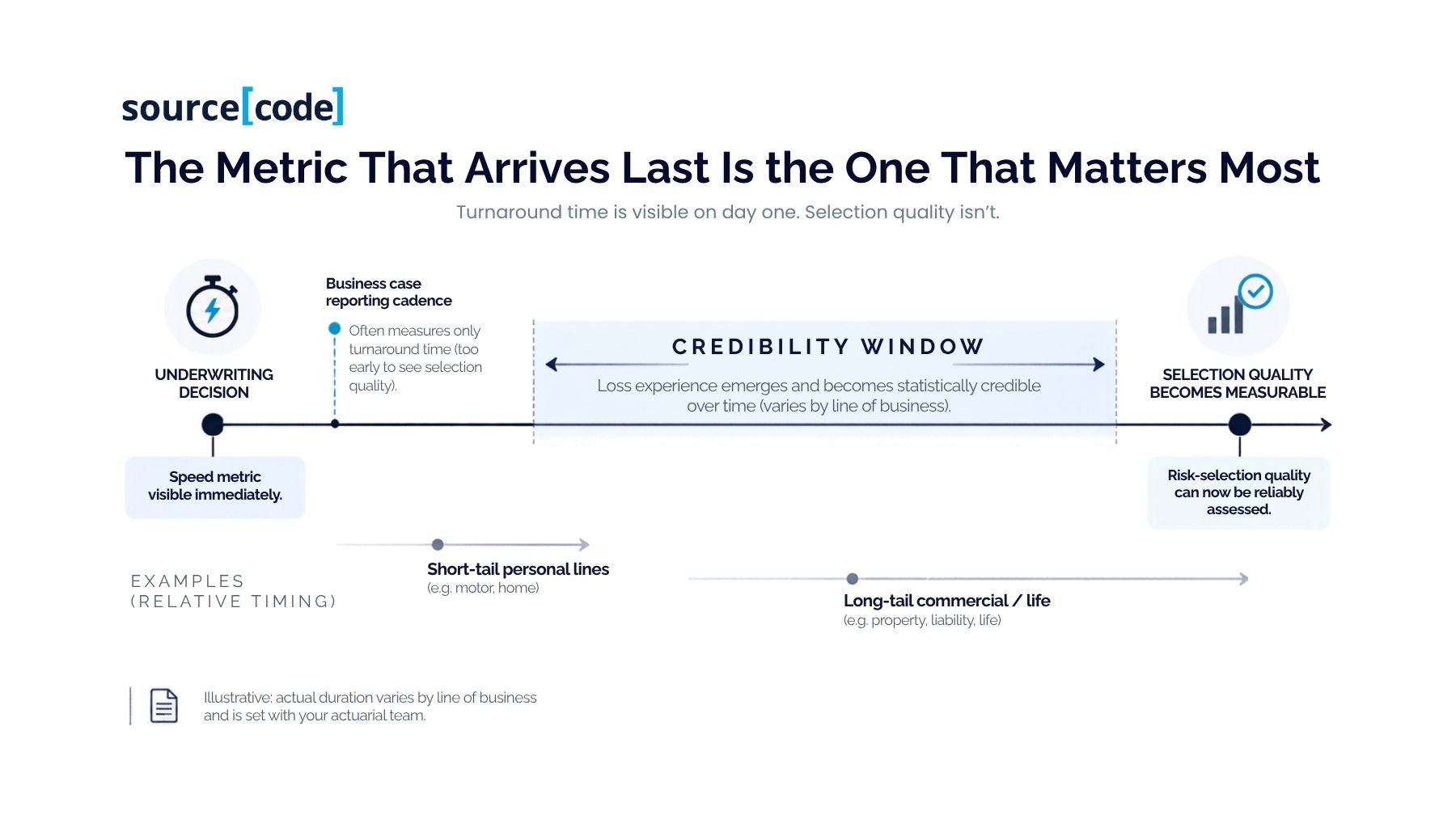
That "won't reveal for a year or more" clause is the entire difficulty. Adverse selection is, definitionally, a mismatch between the risk a carrier believes it has priced and the risk it actually holds - and that mismatch shows up in claims experience, lapse behaviour, and renewal loss ratios, not in a same-quarter processing dashboard. A model that quietly widens auto-approval thresholds to hit an STP target will look successful for every reporting period between the decision and the point the affected cohort's loss experience matures. In short-tail personal lines that might be six to twelve months. In commercial casualty, professional lines, or life, it can be several years. The metric that would tell a CUO the model is mispricing risk is, by construction, the last one to arrive - which is precisely why it is so easy to leave out of a business case that needs to show results this quarter.
The Casualty Actuarial Society has been making a version of this point since long before generative AI made underwriting automation fashionable. In their applied guidance on predictive analytics in underwriting, Hunter and Tan (2017) are explicit that "prediction accuracy has the highest priority" in underwriting-selection applications - which is why practitioners favour gradient boosting, random forests, or neural networks over more interpretable linear models, and why threshold selection for auto-decisioning should be done using confusion-matrix, cost-benefit analysis rather than pure efficiency. That is actuarial discipline built for exactly this problem. It has simply not made its way, in most institutions, from the actuarial function into the AI programme's own reporting.
Regulators are, in this specific respect, ahead of most internal business cases. The NAIC's Model Bulletin on the Use of Artificial Intelligence Systems by Insurers - adopted in December 2023 and now the reference framework a growing number of jurisdictions are aligning to - requires insurers to have processes for "validating, testing, and retesting" AI systems, including "comparing model performance on unseen data available at the time of model development to the performance observed on data post-implementation," and to evaluate "Model Drift to assess the reliability of outputs" (NAIC, 2023). The bulletin's standard is that AI-assisted decisions must not be "inaccurate, arbitrary, capricious, or unfairly discriminatory" - a bar set well above "the model processes files faster." A CUO whose AI programme cannot show the regulator a model-drift and outcome-validation trail has a compliance gap. A CUO whose AI programme cannot show their own board the same thing has a business gap that will surface later, and more expensively, as a loss-ratio surprise.
What most underwriting AI business cases get wrong
The pattern across the market is consistent enough to name: the business case is built and approved on a speed metric, the speed metric is achieved, and the risk-selection question is deferred to "we'll monitor the loss ratio" - without anyone specifying which loss ratio, measured against which comparison cohort, on what cadence, or with what statistical credibility.
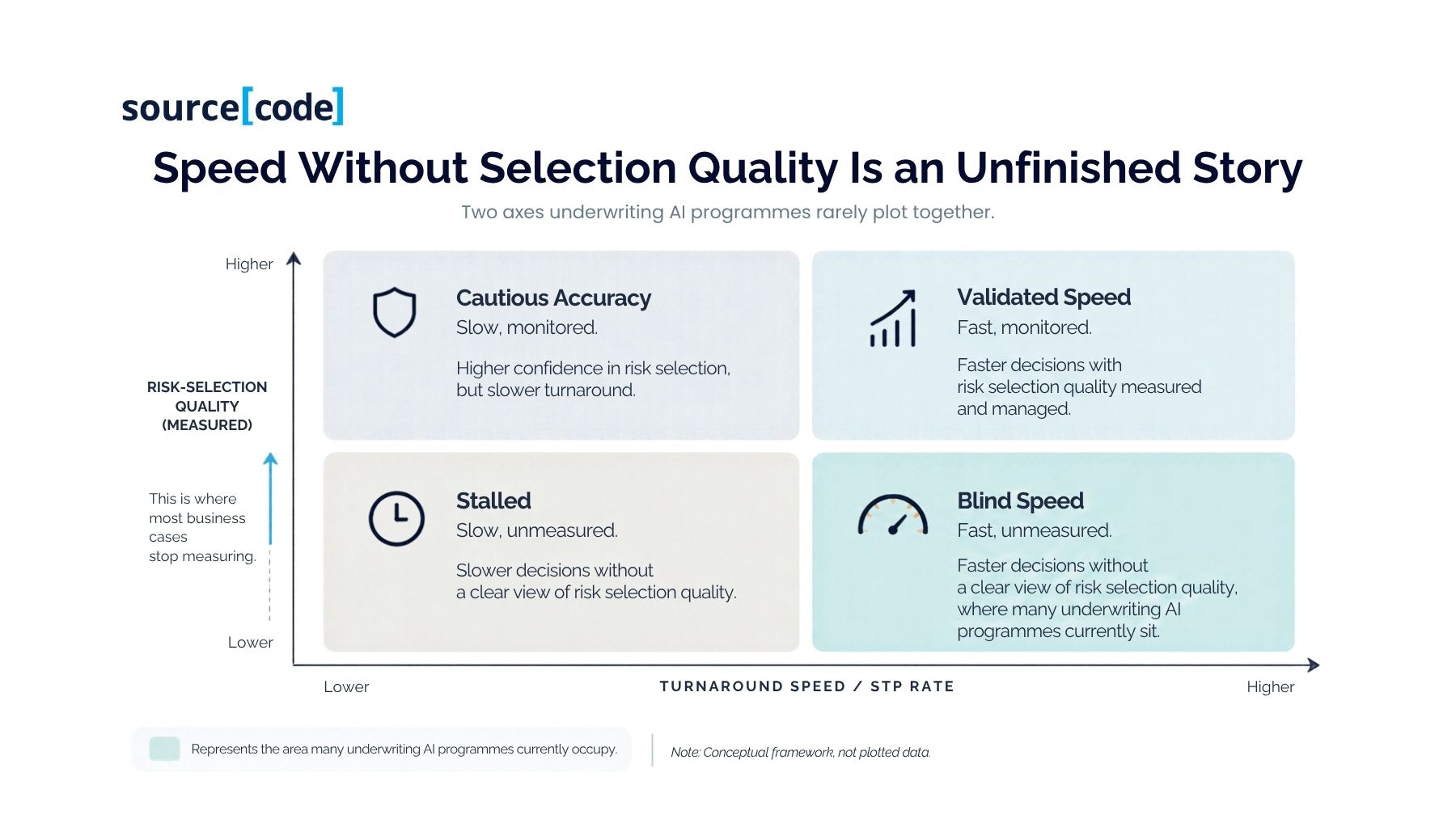
That deferral is where the gap actually lives. "We'll monitor the loss ratio" usually means the portfolio-level loss ratio, reported quarterly, blended across every distribution channel and underwriting method - a number with far too much noise in it to isolate the effect of one automation decision. It is not the same thing as tracking loss ratio, claim frequency, and early lapse rate specifically for the STP-approved segment against a matched sample of the business still being reviewed or referred. Without that channel-level split, a CUO genuinely cannot tell whether STP gains are being funded by better process or by looser selection - and a report from RIBO and the Big Innovation Group's scan of AI in property and casualty insurance flags exactly this exposure at an industry level, warning that AI models "may be inaccurate and low performing in estimating risk," with a resulting danger of "mispricing of risks at-scale, threatening sector fundamentals" if that is not caught early (RIBO/BIT, 2025).
The second recurring gap is timing. Even institutions that do plan to measure selection quality often plan to measure it on the same cadence as the speed metric - quarterly, aligned to the technology programme's reporting cycle - when the underlying claims data simply is not credible yet on that timeline. Reporting a loss-ratio delta six months after go-live, on a cohort too small and too immature to be statistically meaningful, creates false confidence in either direction. The honest version of this metric comes with an explicit statement of when it will become reliable - which is a governance discipline, not a data-science one, and it is usually missing.
The Second Number Framework
source[code]'s view is that this is fixable with a specific governance discipline, not a philosophical shift away from automation. We call it the Second Number Framework: no underwriting AI speed metric should be reported, funded, or renewed without a defined, paired selection-quality metric reported alongside it. It has four parts.
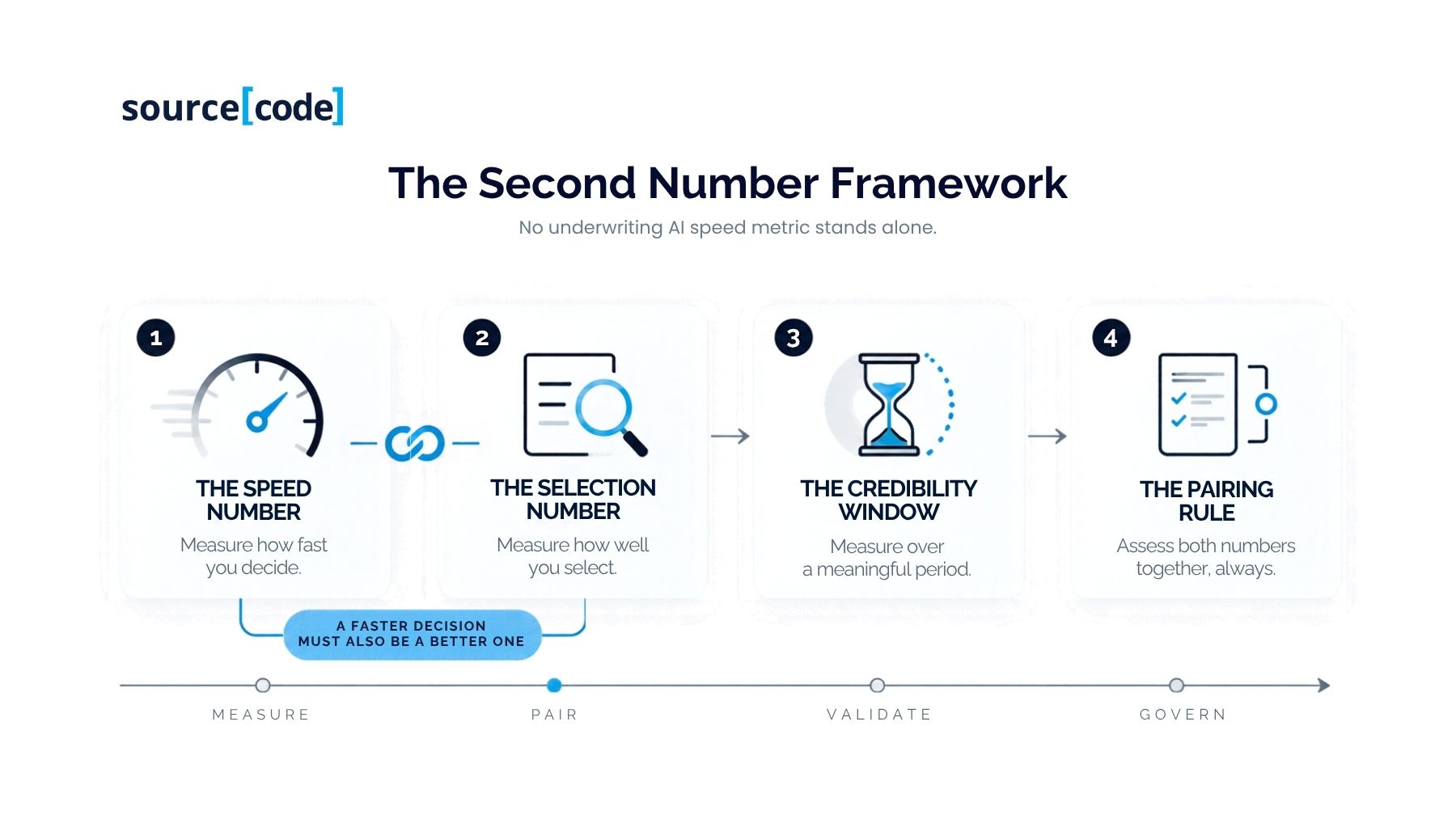
1. The Speed Number. Whatever the programme already tracks - STP rate, average cycle time, quote turnaround, referral rate. Keep it. It is real and it matters.
2. The Selection Number. A defined, cohort-matched measure of risk-selection quality, tracked on the same underwriting decision channel as the Speed Number - not the blended portfolio loss ratio. Candidates include the loss ratio delta between STP-approved and referred business at matched maturity, early-duration (first 90-180 day) claim frequency by decision channel, and bind-to-decline or lapse-rate shifts following an automation change.
3. The Credibility Window. An explicit, actuarially set statement of when the Selection Number becomes statistically usable for the line of business in question - and a stated interim proxy (leading indicators such as referral-override rates, exception patterns, or data-quality flags) to watch in the meantime. This is the discipline most business cases skip: saying out loud that the real answer isn't available yet, rather than implying it already is.
4. The Pairing Rule. A governance rule, not a dashboard feature: no Speed Number goes to a steering committee, investment committee, or board without the Selection Number's current status attached - live, if the Credibility Window has passed, or explicitly marked "not yet credible, N months remaining" if it has not. A speed metric presented alone is, under this rule, an incomplete report rather than a positive one.
The Framework does not slow underwriting down. It changes what "done" looks like for the AI business case - from "we hit the STP target" to "we hit the STP target and can show what it did to selection quality, or we can show exactly when we'll be able to."
Business and technology implications
Running the Second Number Framework is a data and monitoring problem before it is a reporting problem. It exposes a dependency underneath most underwriting AI initiatives, named or not: the underwriting decision and the claims outcome usually live in different systems, on different keys, with no clean way to reassemble "which decision channel produced this loss" months or years later. Building that traceability - decision channel, model version, and override status captured at underwriting and carried through to the claims record - is exactly the kind of data-foundation work we covered in our companion piece on underwriting data readiness ahead of agentic AI. That piece addressed whether the data is ready for an AI system to act on; the Second Number Framework addresses what you then have to measure once it has acted - and both depend on the same underlying discipline: decisions have to be traceable, not just fast.
On monitoring, this typically means extending whatever model-risk or MLOps capability already exists for pricing and fraud models to cover underwriting auto-decisioning specifically - champion/challenger comparisons against the pre-automation referral process, drift alerts aligned to the NAIC's outcome-validation expectations, and a reporting cadence built around the Credibility Window rather than the technology programme's sprint calendar. Most institutions we work with in APAC and the Gulf already have this capability for pricing models. The gap is almost always that underwriting automation was funded and governed by the technology function, on a technology metric, without that capability pulled in from day one.
A fair counterargument: speed genuinely matters commercially
None of this is an argument for slowing underwriting down, and it would be dishonest to present it that way. Distribution economics reward the fastest credible response. Datos Insights' own explanation for why STP concentrates in personal, individual life, annuities and small commercial is that those segments face "competitive speed requirements" as much as they face thin margins (Datos Insights, 2023) - speed is not a vanity metric there, it is close to a condition of remaining in the market. Underwriting technology practitioners describe a self-reinforcing dynamic in commercial lines too: brokers frequently market a risk to several carriers at once, the first clear, credible quote tends to anchor the negotiation, and carriers who are consistently slow see brokers quietly route them fewer opportunities, or only the risks nobody else wanted (Convr, n.d.). source[code]'s own analysis of AI-driven underwriting economics across APAC found SME commercial STP rates at incumbent insurers rarely exceeding 20%, against over 70% at leading digital challengers - a gap wide enough to be a genuine competitive threat, not a rounding error (source[code], 2026).
The fair reading is that speed and selection quality are not opposites to be traded off against each other in the abstract - they are two outputs of the same underwriting decision that happen to be measured on different timelines, and a programme that only reports the fast one has told half the story, not chosen the wrong half. The Second Number Framework does not ask a CUO to choose between them. It asks that both be on the same page.
What underwriting leaders should do next
Three actions turn this from a framework into a working discipline inside an existing underwriting AI programme:
First, before the next steering committee update, ask for the Selection Number that currently sits next to your programme's headline Speed Number. If there isn't one, that is the finding - not a criticism of the technology, a gap in the business case.
Second, commission the Credibility Window for each line of business the AI programme touches. This is an actuarial exercise, not a technology one, and it will differ by line - short-tail personal lines will have a usable answer far sooner than long-tail commercial or life.
Third, put the Pairing Rule into the governance charter for the programme now, while it is still early enough to be a design decision rather than a retrofit. Every future speed metric presented to any committee should carry its paired selection-quality status - live, or explicitly not yet credible - as a condition of being on the agenda at all.
The sourceCode’s perspective
We work with underwriting functions across APAC and the Gulf that are, almost without exception, being asked to move faster - by distribution partners, by boards benchmarking against digital challengers, and by their own operations teams chasing efficiency targets. We are not sceptical of that pressure; it is commercially real, and in competitive personal and small commercial lines it is close to existential.
What we consistently find missing, though, is not the ambition to automate but the governance discipline to pair every speed claim with a selection-quality one, measured honestly on its own timeline rather than forced into the same quarterly cycle as the technology metric. That is a solvable problem - it requires decision-level data traceability, actuarial partnership with the AI programme from the outset, and a governance rule simple enough that nobody can quietly skip it.
It does not require slowing underwriting down, and institutions that treat it as an early design choice rather than a retrofit consistently find it costs far less than institutions that discover the gap after a loss-ratio surprise. Talk to us!
Conclusion
Straight-through-processing rate is a legitimate metric, not a false one - but it answers only the question of how quickly a decision was made, not whether it was the right one. The evidence available across regulatory guidance, actuarial practice, and market benchmarking points the same direction: institutions that report speed without a paired, cohort-level, appropriately time-lagged measure of risk-selection quality are reporting half a business case, and regulators are already signalling that half a business case will not be an acceptable standard of AI governance for much longer.
The fix is not to underwrite more slowly. It is to require a second number, on its own honest timeline, every time the first one is presented - and to treat a speed metric without one as an incomplete report rather than a finished result.
Frequently Asked Questions
Is straight-through-processing (STP) rate a bad metric for underwriting AI? No. STP rate is a legitimate, useful measure of process efficiency and a real driver of competitiveness in fast-moving personal and small commercial lines. The issue is not the metric itself but using it alone, without a paired measure of what happened to risk-selection quality on the same cohort of business.
What is adverse selection in the context of AI underwriting? Adverse selection occurs when the risks a model actually approves differ systematically, and unfavourably, from the risks it was calibrated to approve - for example, because auto-decision thresholds were widened to hit a speed target. It typically shows up as a deteriorating loss ratio, elevated early claim frequency, or unusual lapse patterns in the affected segment, often well after the underwriting decisions themselves were made.
How long does it take before you can actually measure whether an underwriting AI model is mispricing risk? It depends on the line of business. Short-tail personal lines can produce a statistically usable signal within six to twelve months. Long-tail commercial casualty, professional lines, and life insurance can take several years for claims experience to mature enough to be credible. This lag is exactly why the metric is often left out of quarterly technology reporting - and why it needs to be scheduled explicitly rather than assumed.
What does the NAIC Model Bulletin actually require insurers to measure? Adopted in December 2023, the NAIC's Model Bulletin on the Use of Artificial Intelligence Systems by Insurers requires insurers to validate and retest AI systems against post-implementation outcomes, evaluate model drift, and ensure AI-assisted decisions are not inaccurate, arbitrary, capricious, or unfairly discriminatory. It sets an outcome-monitoring standard that goes well beyond processing efficiency, and is increasingly used as a reference point beyond its originating jurisdiction.
Does this mean underwriting AI programmes should slow down to protect risk-selection quality? No. Speed is a genuine commercial driver - brokers and customers reward fast, credible quotes, and carriers with materially lower STP rates than digital-native competitors face a real distribution disadvantage. The recommendation is to pair every speed metric with a selection-quality one on its own credible timeline, not to trade speed away.
What is the Second Number Framework? It is source[code]'s governance framework for underwriting AI reporting: a Speed Number (the existing efficiency metric), a Selection Number (a cohort-matched risk-selection-quality metric), a Credibility Window (the actuarially defined point at which the Selection Number becomes statistically usable), and a Pairing Rule (a governance requirement that no Speed Number is presented to a committee or board without its Selection Number's current status attached).
Reference List
Accenture (2025a) Underwriting Rewritten. Accenture Insurance Insights, 25 August. Available at: https://www.accenture.com/us-en/insights/insurance/underwriting-rewritten (Accessed: 22 September 2026).
Accenture / Reilly, M. (2025b) AI Underwriting: Beyond the Hype. Accenture Insurance Blog, 4 September. Available at: https://insuranceblog.accenture.com/ai-underwriting-beyond-the-hype (Accessed: 22 September 2026).
Convr (n.d.) 7 Ways Commercial Insurers Can Improve Quote Turnaround Time. Available at: https://convr.com/blog/7-ways-commercial-insurers-can-improve-quote-turnaround-time (Accessed: 22 September 2026).
Datos Insights (formerly Aite-Novarica Group) (2023) Straight-Through Processing in Underwriting and Claims: 2023 Update. Available at: https://datos-insights.com/reports/straight-through-processing-underwriting-and-claims-2023-update/ (Accessed: 22 September 2026).
Hunter, R. and Tan, L. (2017) Underwriting Applications of Predictive Analytics. Casualty Actuarial Society Newsletter, 1 March. Available at: https://www.casact.org/newsletter-article/underwriting-applications-predictive-analytics (Accessed: 22 September 2026).
McKinsey & Company (n.d.) The Future Underwriting Operating System: From Inbox to AI Nerve Center. Available at: https://www.mckinsey.com/industries/financial-services/our-insights/insurance-blog/the-future-underwriting-operating-system-from-inbox-to-ai-nerve-center (Accessed: 22 September 2026).
National Association of Insurance Commissioners (NAIC) (2023) Model Bulletin: Use of Artificial Intelligence Systems by Insurers. Adopted 4 December 2023. Available at: https://content.naic.org/sites/default/files/inline-files/2023-12-4%20Model%20Bulletin_Adopted_0.pdf (Accessed: 22 September 2026).
Registered Insurance Brokers of Ontario and Big Innovation Group (RIBO/BIT) (2025) Research Scan on AI in Property & Casualty Insurance. Available at: https://www.ribo.com/wp-content/uploads/2025/03/RIBO-BIT_AI-in-Insurance_Research-Report.pdf (Accessed: 22 September 2026).
source[code] (2026) The Underwriting Renaissance: How AI Is Rewiring Insurance Economics Across APAC. Available at: https://www.sourcecode.com.au/blog/ai-underwriting-claims-apac-insurance-renaissance (Accessed: 22 September 2026).