The Voice AI Inflection: Rebuilding the APAC BFSI Service Layer with Agentic Conversational AI
Executive Summary
The contact center - the single largest cost pool in retail banking and insurance operations - is being rewritten in real time. In the first half of 2026, DBS reported that its Gen-AI-enabled virtual assistants now reach more than 10 million customers across Singapore, Hong Kong and Taiwan, with active use of its corporate assistant "Joy" up 61% and satisfaction up 17% year-on-year (DBS, 2026). Commonwealth Bank's Microsoft-built service platform is now handling more than two million voice and messaging conversations a month, with 84.6% of self-service messaging resolved end-to-end without a human agent (Microsoft, 2026). Gartner forecasts that conversational AI will cut global contact-center agent labor costs by USD 80 billion in 2026 (Gartner, 2025).
Three shifts define this inflection. First, latency and voice quality have crossed the threshold where a synthetic agent is indistinguishable from a human on routine tasks. Second, agentic architectures are converting assistants from answering questions to executing transactions - blocking cards, moving money, resetting mandates - inside a single conversation. Third, regulators in APAC are catching up: APRA's May 2026 letter demanded a "step-change" in AI risk management, CPS 230 now treats voice AI vendors as material service providers, and MAS has released a sector-wide AI risk toolkit (APRA, 2026; MAS, 2026).
For CIOs, CDOs and Heads of Digital, the strategic question is no longer whether to deploy voice AI. It is how to architect a service layer where an agentic model can act on the customer's behalf - safely, auditably, and profitably - without becoming another orphaned pilot. This article sets out the value pools, the architecture, the risk perimeter, and the operating model that separate the leaders from the laggards in APAC BFSI.
From IVR Frustration to a Reworked Service P&L
For twenty years the interactive voice response system was the least loved asset in the bank. It routed, deflected, and frustrated. What replaced it in 2024 and 2025 - LLM chatbots bolted onto legacy telephony - improved language understanding but rarely resolved anything. The customer still ended up in a queue.
The 2026 generation is different. Real-time voice models, agentic orchestration, and integration into core banking and policy admin systems now allow a synthetic agent to authenticate a customer, retrieve their context from twelve systems, execute a servicing task, and log the transaction for audit - in a single sub-thirty-second interaction. The economics change accordingly. McKinsey estimates that generative AI could unlock USD 200-340 billion in annual value for global banking, with the largest single share concentrated in customer operations (McKinsey, 2023; 2025 update). The pattern is the same in insurance: the largest servicing-cost pool sits in policy admin and claims first-notice-of-loss, both dominated by voice.
The APAC opportunity is disproportionately large. The region's banks and insurers carry higher agent-to-customer ratios than European peers, operate across more languages, and face the sharpest demographic pressure on labor costs. Voice AI, done properly, is the single largest lever available to the sector's P&L.
Where the APAC Market Stands in 2026
Three data points frame the environment.
Adoption has moved from proof-of-concept to production. DBS's disclosure that "Joy" and "digibot" now serve more than 10 million customers is a milestone: this is not a pilot. Corporate and SME users can complete simple banking tasks - payments, mandates, servicing - through a single conversation. Individual users can check card usage, track rewards, and block or replace cards through the agentic assistant (DBS, 2026). Commonwealth Bank is running the same play in Australia at multi-million-monthly conversation scale, with self-service resolution above 84% (Microsoft, 2026).
Executive pressure is universal. A 2026 Gartner survey found 91% of customer-service leaders under direct pressure from executives to deploy AI in service operations (Gartner, 2026). The mandate is no longer coming from technology; it is coming from the CFO.
Regulation is now specific, not principles-based. APRA's letter of 30 April 2026 warned that "governance, risk management, assurance and operational resilience practices are not keeping pace with the scale, speed, and complexity of AI adoption" and called out overreliance on vendor demonstrations without independent examination of model behavior (APRA, 2026). MAS, alongside industry, has published a Gen-AI risk management toolkit that treats hallucination control and human-in-the-loop design as substantive compliance obligations for client-facing use cases (MAS, 2026). Under CPS 230, effective July 2026, voice AI providers to Australian regulated entities are classified as material service providers, triggering register, resilience-testing and contractual accountability requirements (Trillet / APRA, 2026).
In plain terms: the technology works, the CFO wants it, and the regulator will now inspect it.
Why Most Deployments Still Underperform
The bank or insurer that treats voice AI as a chatbot upgrade will underdeliver. Four failure modes recur across the region.
The channel trap. Institutions layer a Gen-AI voice agent on top of the existing IVR menu tree, retaining the deflection logic and the escalation ladder. The agent sounds better but the customer journey does not change, so containment rates plateau around 40%.
Read-only assistants. Most APAC deployments still cannot execute a servicing task end-to-end. Without write access to the core banking system, the servicing bus, or the policy admin platform, the assistant becomes an expensive FAQ. The DBS and CommBank leaders have moved past this constraint precisely because they built the orchestration layer.
Hallucination as a policy risk. ASIC's misleading-and-deceptive-conduct standard, MAS's fair-dealing guidelines and HKMA's consumer protection expectations do not tolerate model fabrication. A synthetic agent that invents a fee schedule creates a regulated conduct exposure in real time. Yet more than half of production Gen-AI voice deployments in APAC lack a formal grounding layer, retrieval control or output-classification guardrail.
Vendor concentration and CPS 230 exposure. The largest voice AI stacks in the market rest on two or three foundation-model providers and a small set of speech-to-text and text-to-speech vendors. Under CPS 230 this constitutes a material service provider concentration that Australian institutions must document, test, and be able to exit. Very few have completed that mapping.
What the Next 18 Months Will Bring
Five trends are now visible and will shape the 2026-2027 investment cycle.
From assistants to agents. Agentic architectures - where the LLM plans, decomposes and executes actions across banking APIs - are moving into production. DBS's move to make Joy "fully agentic" in Singapore is the signal event (DBS, 2026). The design center shifts from prompt engineering to policy engineering: what actions the agent may take, under what authentication, with what monetary limit.
Real-time voice-to-voice models. The 2025-2026 generation of speech-native models collapses the latency budget from 1,200-1,500 ms to under 400 ms, indistinguishable from a human turn. This unlocks natural interruption and back-channelling, which in field trials lifts containment by a further 10-15 percentage points.
Multilingual by default. APAC's language complexity - Bahasa, Vietnamese, Thai, Cantonese, Mandarin, Tagalog, Hindi, Japanese, Korean - is now within a single model's tractable range. Regional insurers are consolidating fifteen-language contact centers onto one orchestration stack.
Convergence of voice and identity. Voice-based liveness and behavioral biometrics are being embedded into the assistant's authentication flow, reducing step-up friction while addressing deepfake-cloning risk. This is a live threat: deepfake-driven authorized-push-payment fraud in APAC is growing at triple-digit rates year-on-year.
Regulatory-grade observability. Boards are now asking for transcript-level audit, prompt-version control and outcome classification. In 2027, institutions that cannot prove - to APRA, MAS or HKMA - what the model said, why, and under what version, will face material findings.
Strategic Analysis: The Value Architecture
The economic case for voice AI decomposes into three value pools, each with a distinct architectural implication.
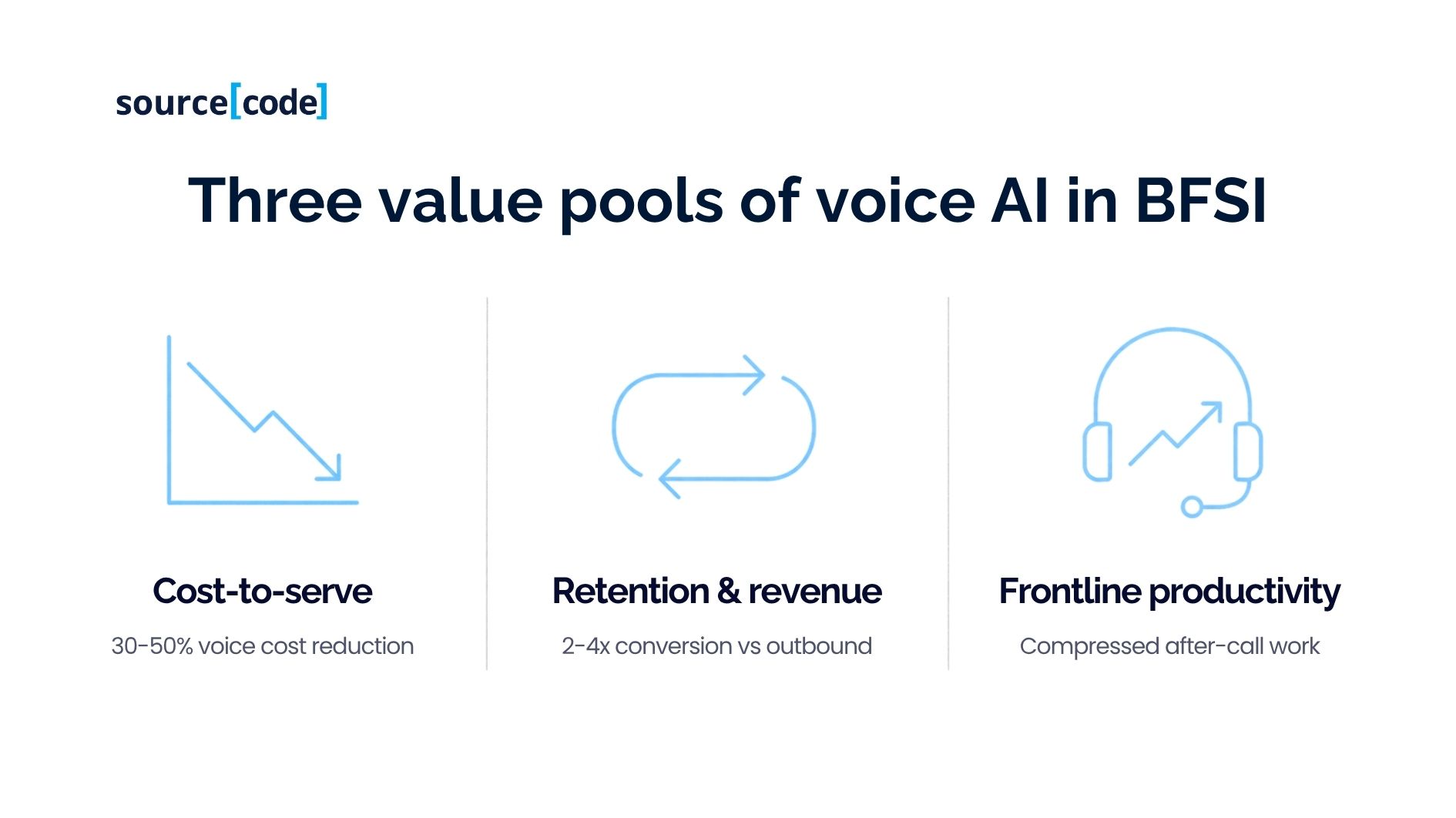
Pool 1: Cost-to-serve reduction. Automating high-volume, low-complexity servicing (balance queries, card blocks, PIN resets, statement requests, address changes, claims FNOL) typically removes 30-50% of contact-center voice cost within twelve months. Gartner's USD 80 billion global figure is anchored here (Gartner, 2025). The architectural requirement is minimal: reliable intent detection, retrieval-augmented answers, and write-back APIs to the servicing bus.
Pool 2: Retention and revenue. Faster resolution and 24/7 availability reduce controllable churn. Personalized, context-aware voice interactions - offer eligibility, product cross-sell, mortgage top-up - convert at rates two to four times higher than outbound telephony. This requires a customer-data platform, a real-time features store, and consent management wired into the conversation.
Pool 3: Frontline productivity. Assistants working alongside human agents ("copilot" mode) compress after-call work, surface next-best-action, and shorten training time. CommBank's specialist workflow - where AI summarizes the conversation and surfaces policy - is the reference pattern (Microsoft, 2026). The architectural requirement is a real-time transcription and knowledge-retrieval layer with strict data-loss-prevention controls.
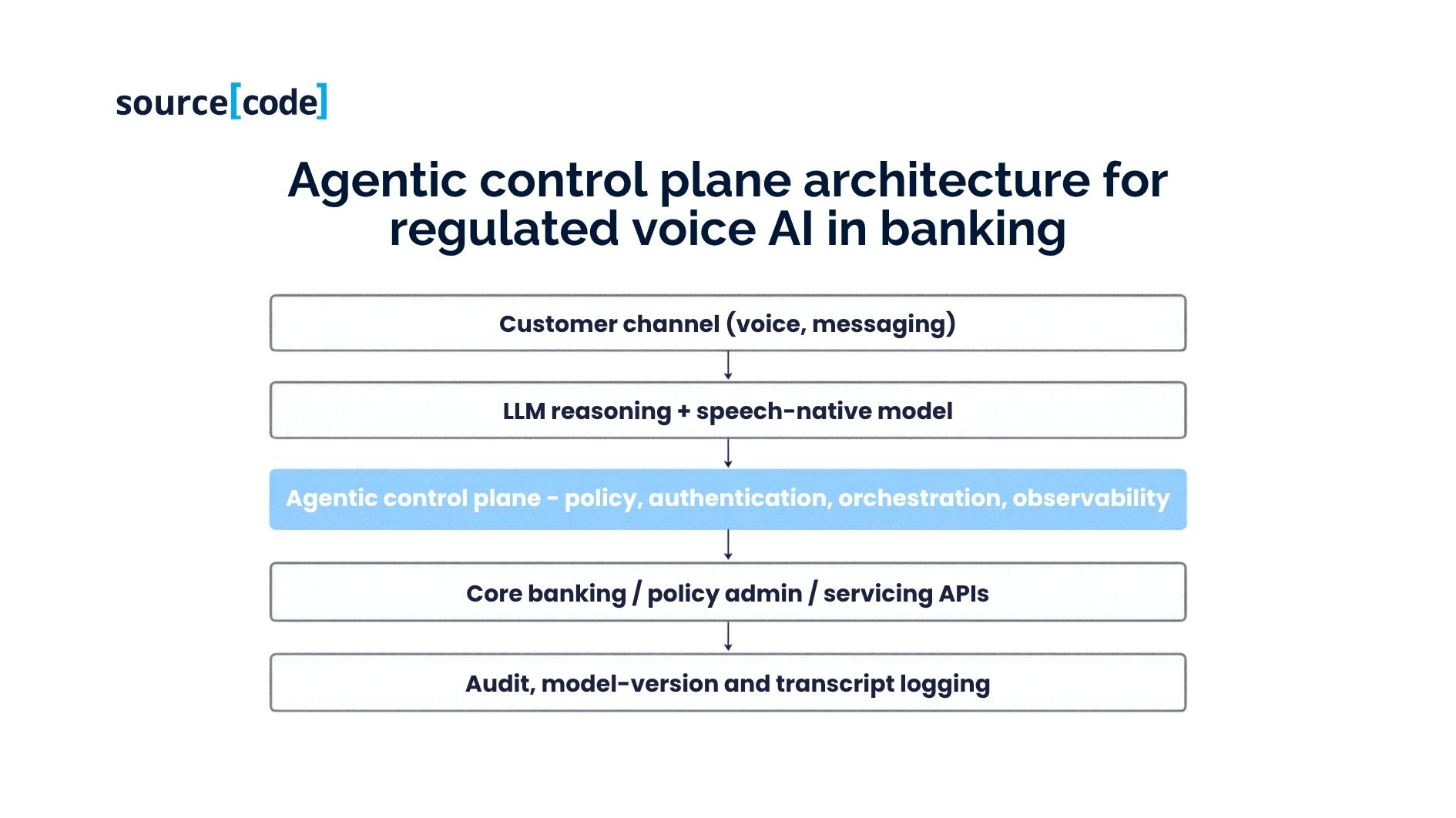
The pattern that separates leaders from laggards is not which model they use. It is whether they have built the agentic control plane: the layer that mediates between the LLM, the authentication service, the transactional systems and the observability stack. The control plane enforces policy (who can do what, up to what limit), maintains the audit trail, and manages the fallback to human agents when confidence drops below threshold. Without it, an institution is running an ungoverned execution surface directly against its core systems.
Real-world Examples
DBS (Singapore, Hong Kong, Taiwan). Joy for corporate and SME customers is now fully agentic in Singapore. Corporate users complete servicing through conversation rather than portal navigation. First-half 2026 metrics: 10 million+ users across three markets, +61% active use, +17% satisfaction on the corporate assistant (DBS, 2026). The strategic lesson: DBS invested in the orchestration layer before scaling the model.
Commonwealth Bank (Australia). Two million+ conversations a month across voice and messaging, 84.6% self-service messaging resolution in May 2026, AI-summarized conversations delivered to specialist agents (Microsoft, 2026). The strategic lesson: automate the routine, augment the specialist, and instrument the whole flow.
Regional insurers (SEA). Multiple Southeast Asian insurers have deployed voice AI for claims FNOL in Bahasa Indonesia, Vietnamese and Thai, reducing first-notice cycle time from days to minutes and lifting straight-through processing on motor and personal-accident classes. The strategic lesson: language coverage compounds ROI in emerging markets where agent scarcity is acute.
A cautionary counter-example. Several APAC institutions launched Gen-AI voice pilots in 2024-2025 that stalled at 25-35% containment. Root cause analysis pointed almost universally to two omissions: no write-back to core systems (so the agent could only inform, not act) and no policy-engineered guardrails (so risk committees blocked scale-up).
Actionable Recommendations for the Executive Team
The following moves separate 2026 leaders from those still running pilots.
For the CEO and Board. Treat voice AI as a P&L programme, not a technology programme. Set a twelve-month target on containment, cost-to-serve and NPS. Require a quarterly board report on model incidents, hallucination rate and audit exceptions. Approve a regulatory-engagement plan with APRA, MAS or HKMA before scale-up.
For the CIO and CTO. Build the agentic control plane before scaling any specific use case. Standardise on an orchestration pattern that separates LLM reasoning from action execution, with policy checks between them. Design for model portability - no institution should be locked to a single foundation-model provider in 2026.
For the CDO and Head of Digital. Prioritise the value pool. Cost-to-serve delivers the fastest, most defensible ROI in the first year. Retention and revenue require investment in real-time data and consent, and pay back in the second year. Sequence accordingly.
For the Chief Risk and Compliance Officer. Stand up an AI-conduct control framework covering hallucination testing, red-team programmes, transcript-level audit, and model-version governance. Under APRA CPS 230, register voice AI vendors as material service providers with tested exit plans. Under the MAS toolkit, document hallucination controls at the use-case level.
For the CHRO and COO. Redesign the operating model for a smaller, higher-skilled contact center. The residual human population becomes exception-handling and complex advisory. Retraining and workforce transition planning start now, not after deployment.
The sourceCode Perspective
Across our APAC engagements, the pattern is consistent: institutions that treat voice AI as a model-selection exercise underdeliver; those that treat it as a service-layer redesign capture the value.
sourceCode partners with banks and insurers on three delivery layers. The agentic control plane, built on secure orchestration frameworks and integrated with core banking, servicing bus and policy admin systems, is where we concentrate our engineering. The regulatory-grade observability stack - transcript audit, prompt-version control, hallucination classification, outcome logging - is what allows a CIO to answer APRA, MAS or HKMA questions with confidence. And the workforce integration model - copilot design, exception handling, retraining - is what allows the P&L benefit to actually land.
Our engineering teams operate in the same time zones as our clients, in the same languages spoken by their customers, and against the same regulatory standards our clients are inspected against. That is how thirty-second production incidents get resolved, not with slideware.
Conclusion
Voice AI has crossed the threshold from novelty to infrastructure. The leaders in APAC BFSI are already in production at multi-million-conversation scale, delivering measurable containment, satisfaction and cost outcomes. The regulators have moved from principles to specifics. The window for CIOs and CDOs to shape their institution's service layer - before the CFO mandates the outcome - is narrow.
The question is no longer whether the technology works. It is whether the institution has the architecture, the controls, and the operating model to let it work safely at scale. Those who build the agentic control plane in 2026 will own the service economics of 2027 and beyond. Those who do not will pay for a decade of catch-up.
If you are shaping your bank or insurer's 2027 service-layer strategy, sourceCode would welcome a conversation about how leading APAC institutions are architecting agentic voice AI - safely, auditably, and for measurable P&L outcomes. Visit https://www.sourcecode.com.au to explore our BFSI engineering capabilities.
Frequently Asked Questions
What is voice AI in banking? Voice AI in banking refers to speech-native artificial-intelligence systems that understand, respond to and - increasingly - execute banking transactions through spoken conversation. The 2026 generation combines low-latency speech models with agentic orchestration to complete servicing tasks end-to-end.
How is voice AI different from a chatbot? A chatbot answers questions in text. A modern voice AI agent understands natural speech, retrieves customer context in real time, executes transactions across core systems, and creates an auditable record - all within a single sub-thirty-second interaction.
What ROI can APAC banks expect from voice AI? Institutions typically remove 30-50% of contact-center voice cost within twelve months on high-volume servicing use cases, with additional gains from retention, cross-sell and specialist-productivity uplift. Gartner forecasts USD 80 billion in global agent-labor savings in 2026 (Gartner, 2025).
What are the main regulatory risks? Hallucination-driven conduct exposure under ASIC, MAS fair-dealing and HKMA consumer-protection standards; operational-resilience obligations under APRA CPS 230 (voice AI vendors as material service providers); and model-governance expectations set out in the MAS AI risk management toolkit (MAS, 2026; APRA, 2026).
Should banks build or buy voice AI? Neither in isolation. Leading institutions buy foundation models and speech capability, and build the agentic control plane, observability stack, and integration to core systems. That architecture keeps them portable across model providers and defensible to regulators.
References
APRA (2026) Letter on managing AI-related risks - expectations for banks, insurers and superannuation trustees, Australian Prudential Regulation Authority, 30 April. Available at: https://www.regulationtomorrow.com/2026/05/apra-calls-for-a-step-change-in-ai-related-risk-management-and-governance/ (Accessed: 11 August 2026).
APRA (2026) CPS 230 Operational Risk Management: implementation guidance. Available at: https://www.apra.gov.au/ (Accessed: 11 August 2026).
BCG (2026) Predictive, generative and agentic AI in financial services, Boston Consulting Group. Available at: https://www.bcg.com/industries/financial-institutions/insights (Accessed: 11 August 2026).
DBS (2026) DBS' Gen AI-enabled virtual assistants reach 10 million customers and go agentic, DBS Newsroom. Available at: https://www.dbs.com/newsroom/DBS_Gen_AI_enabled_virtual_assistants_reach_10_million_customers_and_go_agentic (Accessed: 11 August 2026).
DBS (2026) DBS empowers its Customer Service Officers with Gen AI-powered virtual assistant, DBS Newsroom. Available at: https://www.dbs.com/newsroom/DBS_empowers_its_Customer_Service_Officers_with_Gen_AI_powered_virtual_assistant_to_reduce_toil_and_enhance_customer_experience (Accessed: 11 August 2026).
Gartner (2025, updated 2026) Conversational AI in customer service: cost and adoption forecast to 2026. Available at: https://www.gartner.com/ (Accessed: 11 August 2026).
MAS (2026) AI Risk Management Toolkit for the Singapore Financial Sector, Monetary Authority of Singapore. Available at: https://www.licentium.io/post/mas-mindforge-ai-risk-management-toolkit-singapore-financial-sector-2026 (Accessed: 11 August 2026).
McKinsey & Company (2023, updated 2025) The economic potential of generative AI: the next productivity frontier. Available at: https://www.mckinsey.com/industries (Accessed: 11 August 2026).
Microsoft (2026) How Commonwealth Bank and Microsoft are reimagining the future of customer service, Microsoft Source Asia. Available at: https://news.microsoft.com/source/asia/features/how-commonwealth-bank-and-microsoft-are-reimagining-the-future-of-customer-service/ (Accessed: 11 August 2026).
The Edge Singapore (2026) DBS says its gen-AI enabled virtual assistants reach 10 million customers. Available at: https://www.theedgesingapore.com/news/banking-finance/dbs-says-its-gen-ai-enabled-virtual-assistants-reach-10-million-customers (Accessed: 11 August 2026).
Trillet (2026) Voice AI and APRA CPS 230: operational resilience requirements for AI vendors. Available at: https://trillet.ai/blogs/voice-ai-apra-cps-230-operational-resilience (Accessed: 11 August 2026).