The Underwriting Renaissance: How AI Is Rewiring Insurance Economics Across APAC
APAC insurance has been entering its most significant structural reinvention since the arrival of bancassurance. After a decade in which digitization delivered incremental improvements to distribution and self-service, the economics of the industry are now being rewritten from inside the core, at the point of risk selection, pricing, and loss adjustment. Generative and agentic AI, ambient data from IoT, embedded distribution, and cloud-native policy administration are collapsing the historical trade-off between underwriting rigor, customer experience, and unit cost.
Three shifts define the moment. First, underwriting is moving from periodic ratemaking to continuous, evidence-linked risk intelligence. Second, claims are shifting from a compliance function to a value-creation engine capable of resolving simple losses in minutes rather than weeks. Third, distribution is fragmented into an embedded ecosystem where insurance is offered inside the digital journeys customers already trust - payments, mobility, health, travel, and SME banking. For APAC insurers, the strategic question is no longer whether to adopt AI, but whether their operating model, data foundation, and governance can compound its advantage before challengers do.
This article outlines the industry context, the four transformation vectors reshaping insurance economics, real-world APAC exemplars, and a practical operating playbook for insurance boards and executive teams over the next 18 to 36 months.
Introduction
Insurance is, in essence, a data business dressed as a financial one. Its balance sheet is built on the accuracy with which future losses can be estimated and priced. For most of the industry's history, that accuracy improved slowly - one triennial rate filing, one new statistical table, and one new distribution channel at a time. In 2026, the pace of that improvement has changed. Machine learning has quietly become a routine component of pricing engines. Generative AI has moved from experimentation to production in claims of triage and adviser support. Ambient signals from wearables, connected vehicles, and connected homes are being ingested at a material scale. Regulators, especially in Singapore, Hong Kong, Australia, and Japan, have crystallized expectations for model governance and explainability.
For APAC insurers, this convergence is arriving alongside a demographic and demand story that is simultaneously the industry's greatest opportunity and its most demanding stress test: the region will account for the majority of global insurance premium growth over the next decade, but the customers driving that growth expect digital-native journeys, not the paper-heavy processes of prior generations.
Industry Context: APAC Is the Growth Engine and the Proving Ground
The Swiss Re Institute's global insurance outlook has repeatedly identified emerging Asia as the fastest-growing insurance market, projecting that the region will contribute a disproportionate share of global premium growth through 2035. China alone is expected to become the world's largest insurance market on a nominal-premium basis before the end of the decade, and Southeast Asian markets - Vietnam, Indonesia, the Philippines, Thailand - continue to record double-digit growth in life and health premium (Swiss Re Institute 2024).
Yet growth alone does not translate into value. APAC insurance profitability remains uneven; distribution costs remain among the highest in financial services, and legacy platforms - many still written in COBOL and Adabas - carry a maintenance burden that suppresses the pace of product innovation. McKinsey's Global Insurance Report has consistently documented that the top-quartile insurers globally earn nearly all of the industry's economic profit, while the bottom half destroy value; the same distribution holds within APAC, and the gap is widening (McKinsey 2024).
Three structural pressures are pushing insurers toward AI-native operating models:
- Cost-to-serve. Distribution and administration expenses in APAC life insurance frequently exceed 25% of premium, well above best-in-class levels achieved by digital-first challengers.
- Talent scarcity. APAC actuarial and underwriting talent pipelines are constrained, especially for specialty lines. Automation and AI copilots are no longer optional - they are workforce strategy.
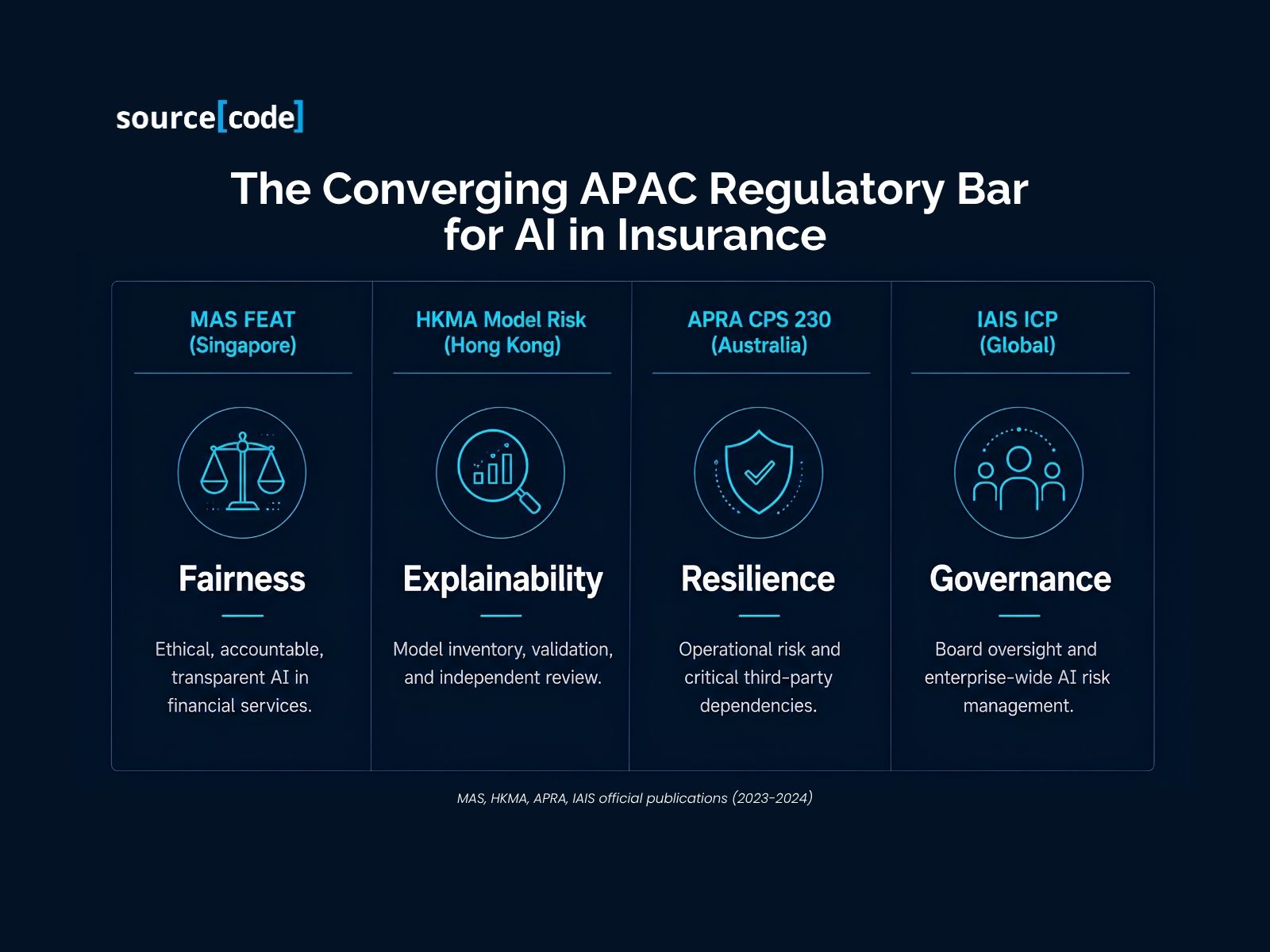
- Regulatory tightening. MAS's FEAT principles, HKMA's model-risk expectations, APRA's CPS 230 operational-resilience regime, and IAIS ICP updates on AI governance are shifting the compliance frontier. Insurers with immature model governance are increasingly exposed.
Current Challenges: Where the Insurance Value Chain Is Under Strain
Executive teams across APAC are contending with four connected challenges:
1. Data fragmentation across the policy lifecycle. Most incumbents run multiple policy administration systems, several claims platforms, and separate CRM and agency-management environments. Customer, exposure, and claims data are duplicated across silos with poor lineage, making it difficult to construct the single, high-fidelity data foundation AI models require. Bain has estimated that insurers spend the majority of their AI project time on data preparation rather than model development (Bain & Company 2024).
2. Underwriting inertia. Personal-lines underwriting is largely automated in mature markets, but commercial and specialty underwriting still depend on submissions received as PDFs, spreadsheets, and emails. Cycle times of two to six weeks are common. Straight-through rates for SME commercial submissions in the region rarely exceed 20% at incumbents, compared with over 70% at leading digital challengers (Accenture 2023).
3. Claims leakage and friction. Deloitte's global claims research has shown that leakage - the gap between what should have been paid and what was actually paid - can exceed 3% of paid losses in general insurance, with much of it attributable to slow triage, inconsistent adjuster decisions, and fraud that goes undetected until it is entrenched (Deloitte 2023). Simultaneously, customer NPS in claims is the single largest driver of retention. Insurers that resolve claims in hours instead of weeks retain customers at materially higher rates.
4. Distribution channel inversion. Bancassurance and tied agency, historically the dominant channels in APAC, are being complemented - and in some segments overtaken - by embedded and digital-direct channels. Insurers that continue to design products around the agent, rather than around the customer's digital journey, will find their unit economics erode as challengers price for the marginal, not the average, customer.
Key Trends: The Four Vectors Rewriting Insurance Economics
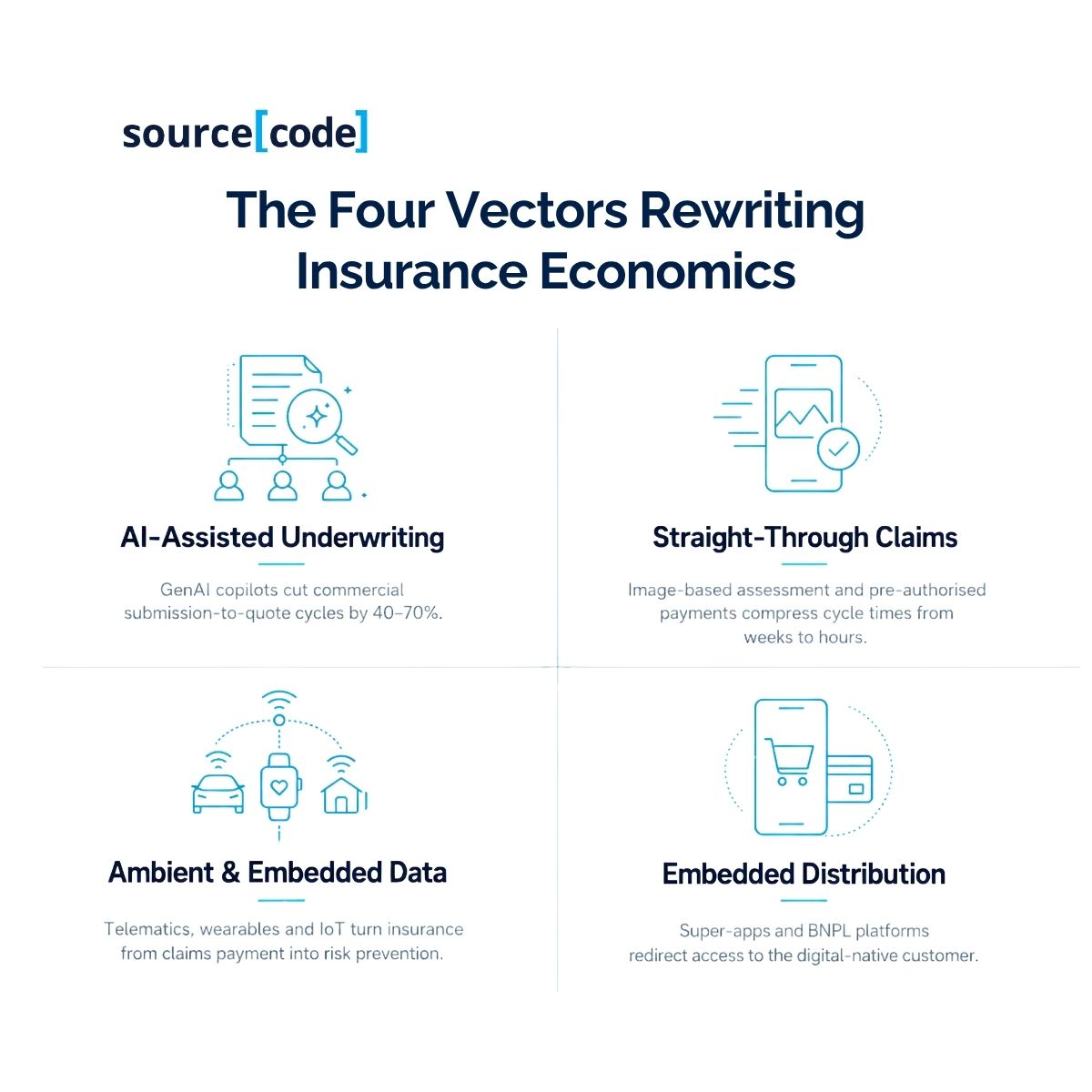
Vector 1 - AI-Assisted Underwriting
The first shift is inside underwriting itself. GenAI models are being deployed as underwriter copilots that read unstructured submissions - brokers' loss runs, engineering reports, medical narratives - extract structured features, and pre-populate the rating engine. This alone can reduce time-to-quote by 40% to 70% in commercial lines, freeing senior underwriters to focus on risk judgement rather than data extraction (McKinsey 2024).
More consequentially, machine-learned pricing models trained on richer, more granular data are lifting predictive power. In motor and health lines, the addition of telematics and wearable signals has demonstrably improved loss-cost prediction, allowing insurers to price micro-segments the traditional bureau tables cannot resolve. The economic logic is straightforward: better risk selection at the point of sale compounds into lower loss ratios over the life of the book.
Vector 2 - Straight-Through Claims
Claims are where AI's near-term ROI is clearest. Automated first-notice-of-loss intake, image-based damage assessment for motor and property, and pre-authorized payments for simple claims are shrinking cycle times from weeks to hours. Ping An's smart-claims capability, which uses AI-based image assessment for motor damage, has been publicly reported to process a substantial share of straightforward claims without human intervention, materially reducing operating costs and improving customer NPS (Ping An 2023).
Equally important, AI-assisted fraud detection has moved from rule-based scoring to graph-based, behaviorally aware models capable of identifying organized fraud rings and synthetic identity claims - increasingly relevant given the rise in deepfake-enabled false claims across the region.
Vector 3 - Ambient and Embedded Data
The rise of connected devices - telematics, wearables, smart-home sensors, IoT-enabled cargo - is turning insurance from a periodic, transactional product into an ambient service. Behavioural pricing in motor, real-time engagement in health, and parametric triggers in agriculture and travel are moving from pilots to core product lines. The World Economic Forum has described this as the shift from "insurance as claims payment" to "insurance as risk prevention", with the strongest early traction in APAC markets that leapfrogged legacy infrastructure (World Economic Forum 2023).
Vector 4 - Embedded Distribution
Embedded insurance - offered inside third-party digital journeys - is projected to reach global gross written premium in the hundreds of billions by 2030, with APAC accounting for a significant share driven by super-app ecosystems and BNPL platforms (BCG 2024). For traditional insurers, embedded is not a niche channel; it is a strategic access route to the digital-native customer, and it demands an entirely different technology stack - API-first product factories, real-time pricing services, and lightweight underwriting rules callable at millisecond latency.
Strategic Analysis: The AI-Native Insurance Operating Model
To convert these vectors into durable advantage, executive teams need a coherent operating model rather than a portfolio of point solutions. The most effective APAC transformations share five design choices.
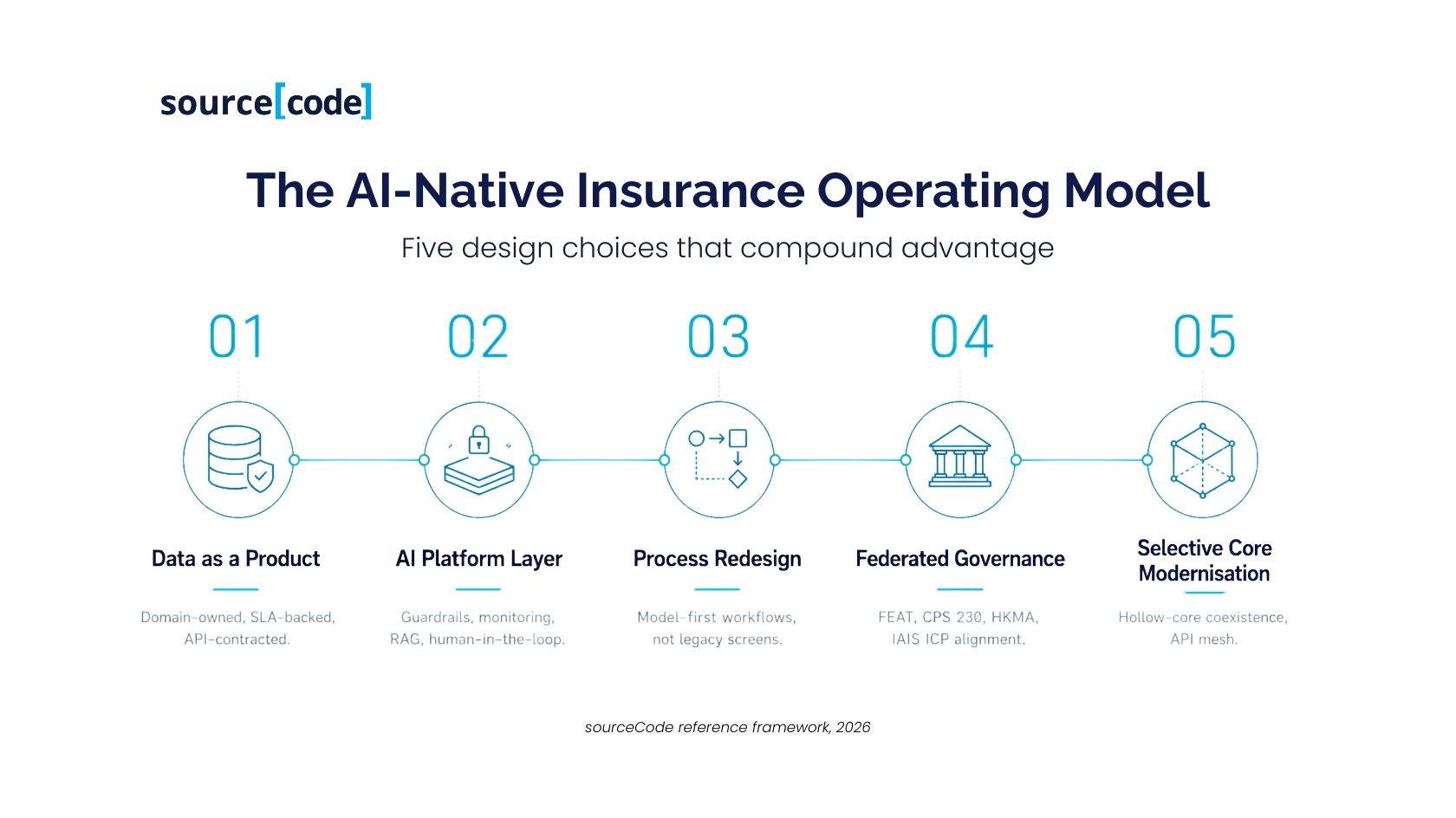
Design choice 1 - Treat data as a product, not a project. The winning insurers have moved beyond enterprise-data-warehouse consolidation to product-oriented data domains - customer, policy, claim, exposure, risk, financial - each with a clear owner, quality SLA, and API contract. This is a foundational condition for any material AI programme.
Design choice 2 - Build a domain-specific AI platform, not a model zoo. A dedicated platform layer for prompt management, retrieval-augmented generation, model monitoring, guardrails, and human-in-the-loop review is what separates production-grade AI from perpetual proof-of-concept.
Design choice 3 - Redesign core processes around the model, not around the legacy screen. Wrapping AI around existing swivel-chair processes captures at most 20% of the available benefit. The remaining 80% comes from redesigning the underwriter's, adjuster's, and agent's workflow so that the AI is the primary source of judgement input, and the human is the final arbiter.
Design choice 4 - Federate governance with a strong center. MAS FEAT, APRA CPS 230, and HKMA's model-risk expectations require a single, defensible view of model inventory, risk classification, and monitoring. A federated model-governance operating model - business-owned, second-line challenged, third-line audited - is now table stakes.
Design choice 5 - Modernize the core selectively, not universally. Complete core replacement remains the highest-risk programme in insurance IT. The pragmatic pattern is a hollow-core or coexistence architecture: stabilize the record of book, extract product logic and pricing into modern services, and expose everything through an API mesh.
Real-World APAC Examples
Ping An (China) - Its AI-driven "One-Minute Auto Claim" and image-based damage assessment have set an industry benchmark. Ping An has publicly reported significant portions of routine motor claims processed automatically, with corresponding reductions in operating cost and improvements in customer experience (Ping An 2023).
AIA (pan-Asia) - AIA has invested heavily in AI-enabled agency productivity tools and digital advice platforms across markets from Hong Kong to Vietnam, using AI to lift adviser productivity and standardize compliance in a highly agent-driven distribution model (AIA 2024).
ZA Insure (Hong Kong) - Built as a cloud-native, virtual insurer, ZA has demonstrated that digitally distributed life products can achieve straight-through issuance rates and cost ratios that legacy insurers find structurally difficult to match, offering a reference model for greenfield digital-insurance plays across APAC (HKMA 2023).
Bajaj Allianz and ICICI Lombard (India) - Leading Indian general insurers have deployed AI-based motor claims and health preauthorization systems, materially reduced cycle times and setting new customer expectations that the wider market is now racing to match (IRDAI 2024).
Singlife and FWD (Southeast Asia) - Both have built modern, API-based cores and are experimenting with AI-assisted underwriting and embedded distribution across ASEAN markets, illustrating the "digital-first regional insurer" archetype.
Actionable Recommendations: An 18-36 Month Executive Playbook
For CEOs, CIOs, and Chief Underwriting/Claims Officers charting the next phase, five moves compound most reliably.
1. Anchor the ambition in loss ratio and expense ratio. Frame AI investment against a combined-ratio thesis, not a slide of use cases. Every material initiative should map to either loss-cost reduction, expense reduction, growth in profitable segments, or capital efficiency.
2. Fix the data foundation in parallel with the first use cases. Data-domain modernization and the first two or three flagship AI use cases should proceed in lockstep; sequential approaches consistently under-deliver.
3. Build the underwriter and adjuster copilot before the customer-facing chatbot. Internal productivity use cases generate faster, more defensible ROI, build muscle for governance, and reduce the reputational risk of early customer-facing missteps.
4. Stand up a fit-for-purpose AI governance function on day one. Treat MAS FEAT, APRA CPS 230, HKMA and IAIS ICP guidance as design inputs rather than compliance overhead. A well-designed governance layer accelerates deployment because it removes the veto points that otherwise appear in production reviews.
5. Pick an embedded distribution beachhead. Even for insurers whose primary channel is agency, one deliberate embedded partnership - with a bank, a mobility platform, or a health ecosystem - is now a strategic learning investment, not a distraction.
The sourceCode Perspective
sourceCode partners with banks, insurers, and financial-services firms across APAC to translate this playbook into engineered outcomes. Our teams work across the layers where insurance transformation succeeds or stalls - data platform modernization, cloud-native core coexistence, AI-assisted underwriting and claims workflows, API-first product factories, and the governance, MLOps, and observability capabilities that keep production AI safe and auditable.
The pattern we see repeatedly among APAC insurers that move from pilot to durable advantage is a disciplined coupling of three capabilities: modern engineering practice, rigorous domain understanding, and pragmatic governance. The insurers who compound the fastest are those who treat AI, data, and platform as one integrated capital-allocation decision - not three separate ones - and who partner with engineering teams that can operate credibly at both the model and the mainframe.
sourceCode's approach is deliberately consultative and delivery-led: we bring reference architectures, accelerators, and engineers who have shipped these platforms in production environments, and we help insurance clients avoid the two most common failure modes - the "AI island" disconnected from the core, and the "core replatform" disconnected from any measurable business outcome.
Conclusion
The next five years will not be kind to insurers that treat AI as a technology programme rather than an economic one. APAC's growth, its regulatory rigor, and the sophistication of its digital customer base will reward insurers who reengineer underwriting and claims around AI-first workflows, treat data as a product, and choose embedded and ambient distribution alongside their traditional channels. The economics of insurance are being rewritten in real time; the winners will be those who redesign the operating model, not those who add another dashboard.
Executive teams do not need to bet the balance sheet to get started. They do, however, need to move with intent, sequence the transformation carefully, and hold themselves accountable to loss-ratio and expense-ratio outcomes rather than proof-of-concept counts.
Looking to build the underwriting, claims, and data foundations of an AI-native insurer - without betting the core? Talk with sourceCode about designing a delivery-ready roadmap that pairs modern engineering with insurance-domain rigor.
Frequently Asked Questions
What is driving AI adoption in APAC insurance in 2026? Three forces: the region's premium growth outpacing global averages, the pressure on distribution and expense ratios, and regulatory expectations from MAS, HKMA, APRA, and IAIS that reward insurers with mature data and model-governance foundations.
Which insurance use cases deliver AI ROI fastest? Underwriter and claims-adjuster copilots, image-based damage assessment, fraud detection, and submission triage. These have short payback periods, defensible governance profiles, and directly move loss and expense ratios.
How does embedded insurance affect traditional APAC insurers? Embedded distribution reshapes access to digital-native customers and demands API-first product architectures and real-time pricing services. Traditional insurers can participate as capacity providers, product manufacturers, or co-branded partners - but only if their technology stack supports millisecond-level integration.
What regulatory frameworks matter most for AI in APAC insurance? MAS FEAT principles (Singapore), HKMA model-risk guidance (Hong Kong), APRA CPS 230 operational resilience (Australia), and IAIS ICP guidance on AI governance. Together they define a converging regional bar for model inventory, explainability, monitoring, and human oversight.
How should insurers sequence AI investment? Anchor on combined-ratio outcomes, fix data foundations in parallel with the first flagship use cases, prioritize internal copilots before customer-facing agents, stand up governance from day one, and pick one embedded-distribution beachhead as a strategic learning investment.
Reference
Accenture 2023, Insurance Technology Vision 2023, Accenture, Dublin.
AIA Group 2024, Annual Report 2023 and Digital Transformation Update, AIA Group Limited, Hong Kong.
Bain & Company 2024, Insurance Data and Analytics: From Ambition to Impact, Bain & Company.
Boston Consulting Group (BCG) 2024, The Embedded Insurance Opportunity, BCG.
Deloitte 2023, Global Insurance Outlook 2024: Reimagining Claims for the Digital Era, Deloitte Insights.
Hong Kong Monetary Authority (HKMA) 2023, Virtual Insurer Framework and Digital Insurance Update, HKMA, Hong Kong.
Insurance Regulatory and Development Authority of India (IRDAI) 2024, Annual Report and Digital Insurance Overview, IRDAI, Hyderabad.
McKinsey & Company 2024, Global Insurance Report 2024 and State of the Insurance Industry, McKinsey & Company.
Ping An Insurance Group 2023, Annual Report 2022 and Technology Disclosures, Ping An, Shenzhen.
Swiss Re Institute 2024, World Insurance: Emerging Markets Lead the Recovery, Sigma Series, Swiss Re, Zurich.
World Economic Forum (WEF) 2023, The Future of Insurance: Rewriting the Rules of Risk, WEF, Geneva.