The Tokenized Bank: APAC's Programmable Finance Moment and the New CIO Mandate
Tokenization has quietly crossed the line from experiment to infrastructure. In the last twelve months, the Monetary Authority of Singapore (MAS) has expanded Project Guardian to more than forty financial institutions across seven jurisdictions, the Hong Kong Monetary Authority (HKMA) has moved Project Ensemble from sandbox to a live 2026 pilot known as EnsembleTX, and DBS, OCBC and UOB have completed the first interbank overnight lending trial using Singapore-dollar wholesale central bank digital currency (CBDC). Ant International, HSBC and Swift have completed a cross-border tokenized-deposit proof of concept over the existing ISO 20022 rails. The total tokenized real-world asset (RWA) market sits near USD 27.6 billion today, less than one percent of BCG's 2033 demand estimate of nearly USD 19 trillion.
For APAC bank CIOs, CTOs and CDOs, the implication is not that a new asset class is arriving. It is that the settlement rails, the liability structure of the bank and the operating model of treasury, custody and post-trade are being rebuilt in parallel. The banks that will win this cycle are the ones that treat tokenization as an enterprise architecture programme, not a blockchain project. This article sets out why the shift is happening now, what regulators in Singapore and Hong Kong have made unambiguous, and the six architectural moves that separate leaders from followers heading into 2027.
For most of the last decade, tokenization in banking was a slide in an innovation deck. It was demonstrated at conferences, piloted in sandboxes and quietly parked when the return on investment could not be defended to the board. That posture is no longer defensible. The three preconditions that historically blocked scale: regulatory clarity, institutional-grade infrastructure, and connectivity to legacy payment rails - have all shifted in APAC within the last eighteen months.
The result is a rare moment where technology decisions taken this financial year will shape competitive positions for the next decade. Boards are already asking whether their bank will be a node on the emerging shared ledger, an operator of it, or a customer of someone else's. That question sits squarely on the desk of the CIO.
Industry Context: Three Signals That the Curve Has Bent
Signal one: regulators have moved from observation to orchestration. MAS expanded Project Guardian in late 2024 to include foreign exchange, fixed income and asset management workstreams, and has published tokenization frameworks that member banks are now embedding into product design (Monetary Authority of Singapore, 2024). In November 2025 HKMA announced the next phase of Project Ensemble, moving from experimentation to real-value transactions in tokenized deposits and digital assets across the whole of 2026 (Hong Kong Monetary Authority, 2025). The pilot uses the HKD Real Time Gross Settlement (RTGS) system to settle interbank tokenized-deposit transactions, and includes Standard Chartered, HSBC, Bank of China (Hong Kong), BlackRock and Franklin Templeton.
Signal two: tier-one banks have committed real balance sheet. HSBC has extended its Tokenized Deposit Service beyond Hong Kong and Singapore to United States corporate clients, with 24/7 instant cross-border settlement (PYMNTS, 2026). Ant International is now routing real corporate treasury flows through tokenized deposits at HSBC and DBS in multiple currencies. In December 2025, Ant International, HSBC and Swift completed a proof of concept demonstrating that tokenized deposits can move over the existing Swift network using ISO 20022, removing the need for a parallel messaging fabric (Swift, 2025).
Signal three: the market is small but the slope is steep. The Bank for International Settlements has become the intellectual anchor of the movement, with the Innovation Hub advancing Project Agora on cross-border tokenized commercial-bank money and central-bank money on a unified ledger (BIS, 2024). BCG's 2025 update with Ripple estimates demand for tokenized real-world assets will reach approximately USD 9.4 trillion by 2030 and USD 18.9 trillion by 2033 (BCG and Ripple, 2025). McKinsey's more conservative view still puts tokenized financial assets at USD 2 trillion by 2030, excluding stablecoins, tokenized deposits and CBDCs to avoid double-counting (McKinsey and Company, 2024). Standard Chartered's broader projection reaches USD 30 trillion by 2034 when trade finance and bonds are included.
None of these forecasts require a technology miracle. They require banks to move flows off batch, off T+2, and off bilateral reconciliation.
The Current Challenges: Why This Is Harder Than a Blockchain Project
Most tokenization proofs of concept in APAC banks have succeeded technically and stalled operationally. The pattern is familiar. A trading desk sponsors a pilot; a small engineering team builds a smart-contract stack against a permissioned network, an asset is issued, a coupon is paid, and the demonstration ends. Nothing changes in the core banking system. Nothing changes in the general ledger. Nothing changes in the risk and compliance operating model. The pilot never becomes a product.
Four barriers explain the stall.
The first is liability accounting and legal characterization. A tokenized deposit is a bank liability. It must be reflected in the general ledger with the same rigor as any other deposit, must be reconciled against the tokenized representation continuously, and must be recoverable in a wind-down. Very few APAC banks have retrofitted their core to treat a distributed-ledger balance as a first-class object rather than a suspense account.
The second is atomic settlement across heterogenous ledgers. The value of tokenization is delivery versus payment on a single settlement horizon. That is straightforward when the security leg and the cash leg live on the same chain. It is materially harder when the cash leg is a wholesale CBDC on one ledger; the security leg is a tokenized bond on another, and the custodian lives on a third. This is the interoperability problem that projects such as Agora and Ensemble are attempting to solve, and it will not be solved by any single bank in isolation.
The third is operational readiness for 24/7 finality. Banks are structured around cut-off times, market opening hours and end-of-day batch. A tokenized-deposit service that settles instantly at any hour requires treasury desks, liquidity risk models, sanctions screening and payment operations to run continuously. This is a personnel, process, and observability problem before it is a technology problem.
The fourth is governance and control debt. Model risk management, third-party risk management, and change management frameworks were written for centralized systems. Smart contracts are code that moves value, and code that moves value must be governed with the same seriousness as a payment engine. Most banks do not yet have a control library for on-chain logic that satisfies internal audit, let alone the regulator.
Key Trends Shaping the 2026-2027 Horizon
From token issuance to token circulation. The first wave of tokenization measured success by whether an asset could be issued on a ledger. The second wave measures success by whether that asset can be used as collateral, transferred, financed, and unwound within existing risk frameworks. Circulation, not issuance, is now the metric that matters.
Convergence of payments and securities infrastructure. The historical separation between payments rails and securities settlement rails is dissolving. When cash is a token and a bond is a token, the same shared ledger can host both legs. This is the single most consequential architectural shift in wholesale banking since the introduction of RTGS.
Rise of tokenized bank liabilities as the settlement asset of choice. BIS and industry participants have converged on the view that tokenized commercial-bank deposits, backed by wholesale CBDC, are the pragmatic settlement asset for institutional flows. Stablecoins remain relevant for specific corridors, but the regulated on-chain money that banks will build products around is a deposit token, not a stablecoin.
Standardization over proprietary chains. The BLOOM initiative launched in October 2025 to establish settlement standards for tokenized bank liabilities and regulated stablecoins across G10 and Asian currencies. ISO 20022 has emerged as the common data language, as demonstrated by the Ant-HSBC-Swift proof of concept. Banks that build against proprietary chains without standards alignment will accumulate lock-in cost.
Regulators are underwriting the infrastructure risk, not the product risk. MAS and HKMA are enabling shared infrastructure and setting settlement rules. They are not, and will not, absolve the product owner of accountability for suitability, disclosure or capital treatment. This raises the bar on internal governance rather than lowering it.
Strategic Analysis: The Real Choice Is About Position on the Stack
Every APAC bank now faces a strategic positioning choice on a stack that has four layers.
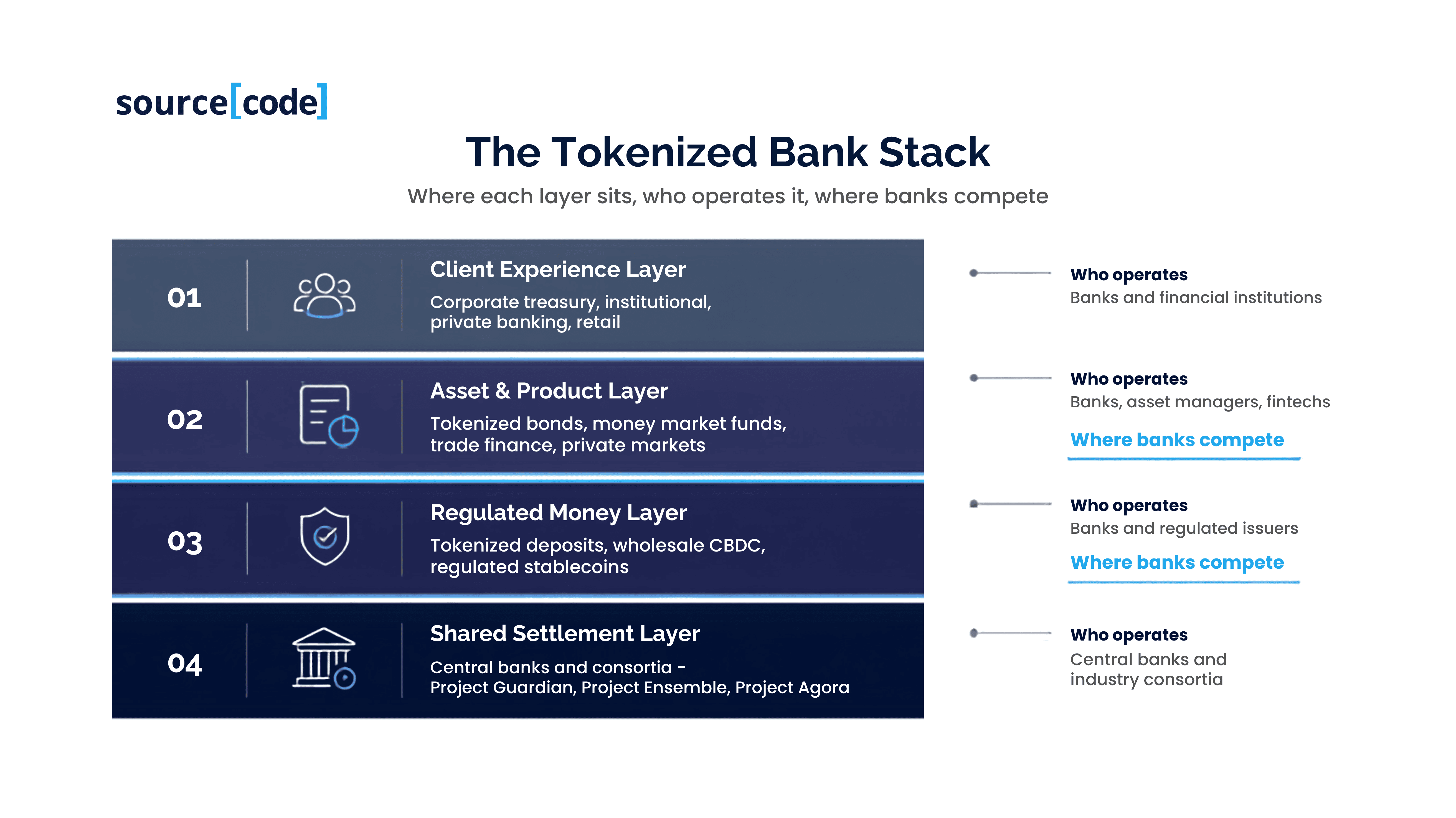
At the base sits the shared settlement layer, which will be dominated by central banks and consortia such as those forming inside Project Ensemble and Project Guardian. Very few institutions will operate this layer. Most will consume it.
Above that sits the regulated money layer, comprising tokenized deposits, tokenized central bank money and, in specific corridors, regulated stablecoins. This layer is where a bank monetises its balance sheet. It is where HSBC, DBS, OCBC, UOB, Standard Chartered and Bank of China (Hong Kong) are placing early bets. It is where a mid-tier bank can still credibly compete, provided it moves inside the next two financial years.
Above that sits the asset and product layer, where tokenized bonds, tokenized money market funds, tokenized trade finance instruments and tokenized private-market assets are issued, distributed and serviced. This is where wealth, asset management, and transaction banking businesses will find new revenue lines. It is also where user experience and distribution partnerships matter most.
At the top sits the client experience layer, where corporate treasurers, institutional investors, private-bank clients and, eventually, retail customers interact with tokenized products through familiar interfaces. Most clients will neither know nor care that the underlying is tokenized. They will care that settlement is instant, transparent, and available on their calendar.
The strategic error to avoid is confusing layer one and layer four. Building a bespoke chain is not a strategy. Building a differentiated product on top of a shared, regulated layer is.
Real-World Examples: What Is Already Live in APAC
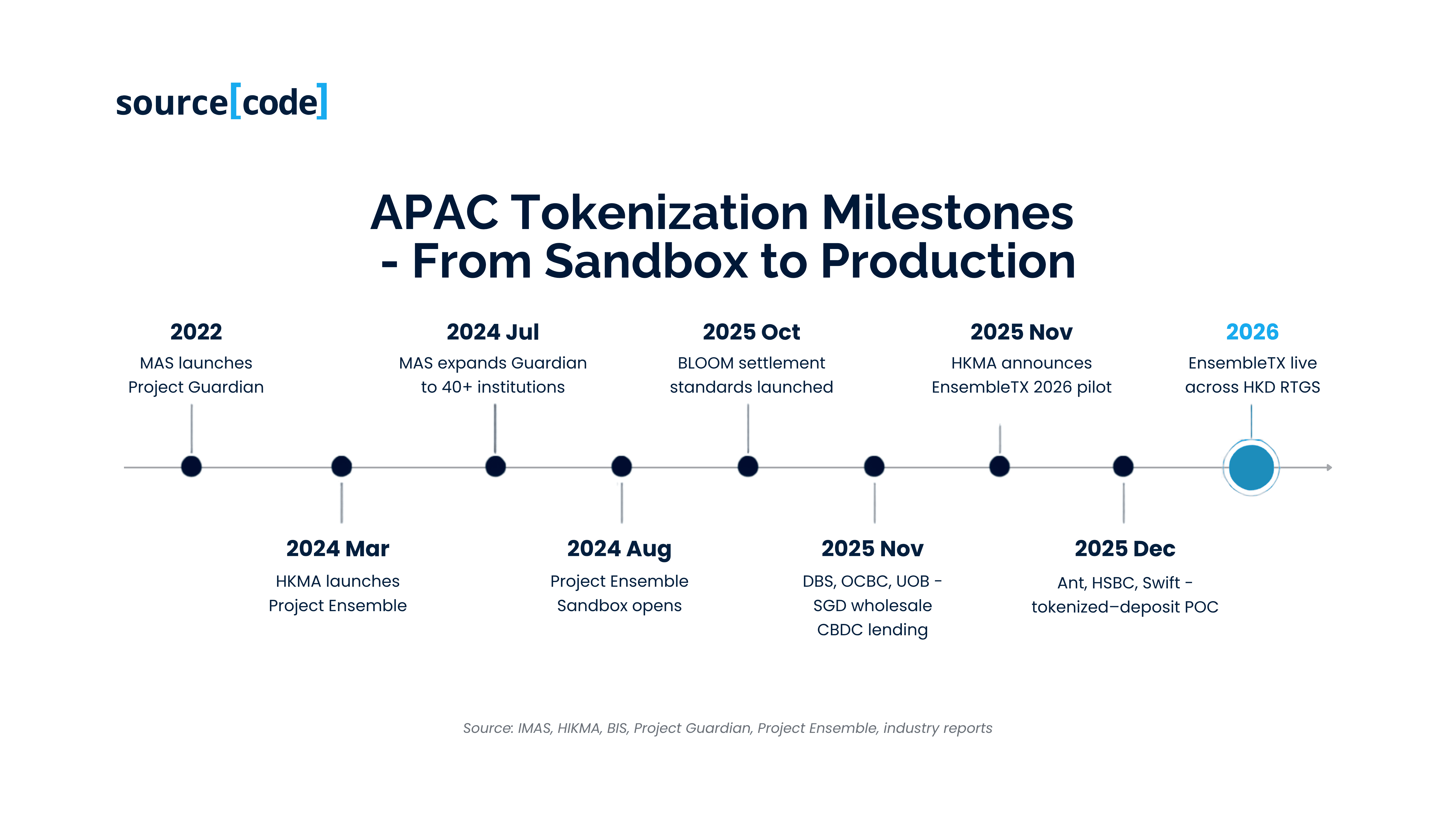
Singapore: interbank lending on wholesale CBDC. In November 2025 DBS, OCBC and UOB completed an overnight interbank lending trial using Singapore-dollar wholesale CBDC issued by MAS. This is the first production-adjacent use of a domestic wholesale CBDC by APAC's largest banks and represents the maturation of the Orchid Blueprint into daily treasury practice.
Hong Kong: EnsembleTX in production for tokenized money market funds. The 2026 phase of Project Ensemble is not a pilot in the traditional sense. It is a live-value environment where participating banks and asset managers, including BlackRock and Franklin Templeton, are executing tokenized money-market-fund transactions against tokenized deposits and settling through the HKD RTGS system.
Cross-border corporate treasury: Ant International over HSBC and DBS. Ant International is using tokenized deposits at HSBC and DBS across multiple currencies for real-time payments. The December 2025 Swift proof of concept demonstrated that these flows can be orchestrated over Swift using ISO 20022, offering a path to scale that does not require every bank to build proprietary integration.
Global reference points that inform APAC. J.P. Morgan's Kinexys platform continues to process billions in daily tokenized flows and is a Project Guardian participant. HSBC's Orion platform is offering tokenized gold and tokenized deposits to clients. These reference points shorten the learning curve for APAC banks willing to partner or observe closely.
Actionable Recommendations: Six Moves for CIOs and CDOs Over the Next 18 Months
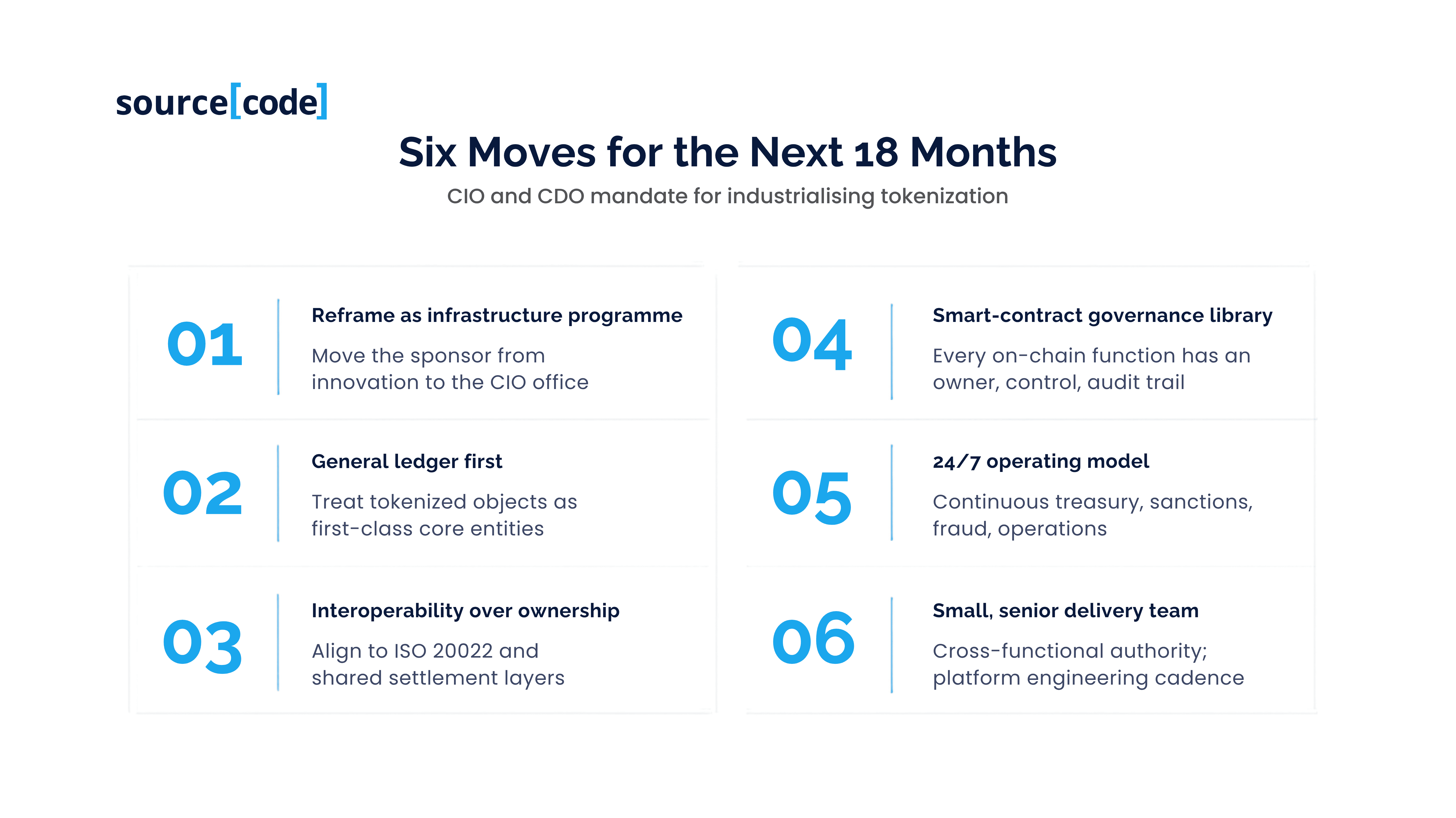 **
One. Reframe tokenization from a product bet to an infrastructure programme.** Move the sponsor from the innovation function to the CIO office. Establish a tokenization architecture board with treasury, risk, operations, product and technology at the table. Publish a target-state architecture that shows how tokenized assets are ledgered, reconciled, and reported end-to-end.
**
One. Reframe tokenization from a product bet to an infrastructure programme.** Move the sponsor from the innovation function to the CIO office. Establish a tokenization architecture board with treasury, risk, operations, product and technology at the table. Publish a target-state architecture that shows how tokenized assets are ledgered, reconciled, and reported end-to-end.
Two. Treat the general ledger as the first migration, not the last. The core accounting stack must recognize tokenized deposits and tokenized assets as first-class objects. Retrofitting this later is the single most expensive mistake a bank can make. This is where core modernization programmes and tokenization programmes must be sequenced together, not run in parallel silos.
Three. Choose interoperability over ownership. Align to emerging standards, notably ISO 20022 for messaging, and to the shared settlement layers being stood up by MAS, HKMA and BIS. Avoid heroic bets on proprietary chains. The moat is in product, distribution and client experience, not in the ledger.
Four. Build a smart-contract governance library. Every piece of on-chain logic that moves value must have a control owner, a change process, an audit trail, an incident response playbook and a defined model risk classification. This library is a prerequisite for regulator approval to move from sandbox to production. It is also the single most transferable asset across use cases.
Five. Redesign the operating model for 24/7 finality before you launch the product. Treasury liquidity forecasting, sanctions screening, fraud monitoring and payment operations must operate continuously. Where continuous operation is uneconomic, design compensating controls and communicate them clearly to clients. Do not launch a real-time product on a batch operating model.
Six. Establish a small, senior, cross-functional delivery team with real authority. The banks that are shipping tokenized products in APAC are doing so with lean, empowered teams that combine deep engineering, product management, legal, risk and operations. This is a platform engineering problem more than a research problem. It rewards discipline and delivery cadence over experimentation.
The sourceCode Perspective
At sourceCode, we work with banks and insurers across APAC on the engineering-heavy end of digital transformation, from core modernization and cloud transformation to platform engineering and data platforms. What we consistently observe in tokenization programmes is a mismatch between board ambition and the underlying enterprise readiness. Boards approve pilots; the pilots succeed; the operating model, the ledger and the control framework are not ready to industrialize them.
The remedy is unglamorous. It is target-state architecture that treats tokenized objects as first-class citizens of the general ledger. It is platform engineering that lets small product teams ship against a shared, governed foundation. It is a control library for on-chain logic that internal audit and the regulator will accept. It is a cloud posture that supports 24/7 finality without introducing new concentration risk. These are the capabilities we help clients design and build, in partnership with their engineering leaders, so that the second and third product launches take weeks rather than quarters.
The banks that treat 2026 as the year they industrialize tokenization will spend 2027 compounding advantage. The banks that treat it as another sandbox will spend 2027 catching up.
Conclusion
Tokenization in APAC has quietly matured. The regulators have moved. The tier-one banks have committed. The standards are converging. The market forecasts are large enough to matter, and the current base is small enough that positions taken now will define the decade. For CIOs and CDOs, the strategic question is no longer whether tokenization is real. It is which layer of the stack the institution will own, which layers it will consume, and whether the ledger, the operating model and the governance framework are ready for the flows that are already in production at peers.
The window to build enterprise readiness is short. The engineering and governance work required is well understood. The competitive price, measured in balance-sheet efficiency, new revenue lines, and client stickiness, is significant.
Exploring how your institution should position on the tokenization stack, or how to industrialise a tokenized-deposit or tokenized-fund pilot into a production capability? Talk with sourceCode about building the enterprise architecture, platform engineering and governance foundations that make programmable finance work at scale. Visit www.sourcecode.com.au to start the conversation.
Frequently Asked Questions
What is a tokenized deposit and how is it different from a stablecoin? A tokenized deposit is a digital representation of a commercial-bank deposit on a distributed ledger, issued and backed by the depositing bank and reflected as a liability on that bank's balance sheet. Unlike most stablecoins, it is a regulated bank liability, is subject to deposit-taking supervision, and can be settled against wholesale central bank money.
Is asset tokenization actually in production in APAC in 2026, or still in pilot? Both. Wholesale CBDC-settled interbank lending has been completed by Singapore's three largest banks. Hong Kong's Project Ensemble is running live-value transactions across 2026 through EnsembleTX. Cross-border tokenized-deposit corporate flows are live at HSBC and DBS. Retail-scale tokenized products remain limited, but institutional flows are moving into production.
Which regulators in APAC are leading on tokenization? MAS in Singapore, through Project Guardian and the Orchid Blueprint, and HKMA in Hong Kong, through Project Ensemble and EnsembleTX, are the two most active. Both work closely with the Bank for International Settlements through Project Agora and related initiatives.
What is the most common reason tokenization pilots fail to scale? Operating model and general-ledger readiness. The technology usually works. The core banking system, the reconciliation process, the control framework and the 24/7 operating capability are what typically prevent industrialization.
How large is the tokenization opportunity for APAC banks? Estimates vary. BCG projects approximately USD 9.4 trillion in tokenized RWA demand globally by 2030, rising to USD 18.9 trillion by 2033. McKinsey's narrower estimate is USD 2 trillion by 2030. APAC, led by Singapore and Hong Kong, is positioned to capture a disproportionate share given regulatory leadership.
References
Bank for International Settlements, 2024. Project Agora: Central banks and banking sector to explore tokenization of cross-border payments. [online] Available at: https://www.bis.org/about/bisih/topics/fmis/agora.htm [Accessed 20 July 2026].
Bank for International Settlements, 2024. Leong Sing Chiong: Tokenization in financial services - pathways to scale. [online] Available at: https://www.bis.org/review/r241104k.htm [Accessed 20 July 2026].
Boston Consulting Group and Ripple, 2025. Approaching the Tokenization Tipping Point. [online] Available at: https://www.bcg.com/publications/2025/approaching-tokenization-tipping-point [Accessed 20 July 2026].
Hong Kong Monetary Authority, 2024. HKMA launches Project Ensemble Sandbox to accelerate adoption of tokenization. [online] Available at: https://www.hkma.gov.hk/eng/news-and-media/press-releases/2024/08/20240828-3/ [Accessed 20 July 2026].
Hong Kong Monetary Authority, 2025. HKMA announces the new phase of Project Ensemble to support real-value transactions in tokenized deposits and digital assets. [online] Available at: https://www.hkma.gov.hk/eng/news-and-media/press-releases/2025/11/20251113-3/ [Accessed 20 July 2026].
International Swaps and Derivatives Association and Ant International, 2025. Industry Report on the Use of Tokenized Bank Liabilities for FX Settlement and Cross-Border Payments under Project Guardian. [online] Available at: https://www.isda.org/2025/tokenised-bank-liabilities-report [Accessed 20 July 2026].
McKinsey and Company, 2024. From ripples to waves: The transformational power of tokenizing assets. [online] Available at: https://www.mckinsey.com/industries/financial-services/our-insights/from-ripples-to-waves-the-transformational-power-of-tokenizing-assets [Accessed 20 July 2026].
Monetary Authority of Singapore, 2024. MAS announces expansion of industry collaboration to scale asset tokenization for financial services. [online] Available at: https://www.mas.gov.sg/news/media-releases/2024/mas-expands-project-guardian [Accessed 20 July 2026].
Monetary Authority of Singapore, 2024. Project Guardian. [online] Available at: https://www.mas.gov.sg/schemes-and-initiatives/project-guardian [Accessed 20 July 2026].
PYMNTS, 2026. HSBC Extends Tokenized Deposit Service to US Firms. [online] Available at: https://www.pymnts.com/blockchain/2026/hsbc-extends-tokenized-deposit-service-to-us-firms/ [Accessed 20 July 2026].
Standard Chartered and Synpulse, 2024. Real-World Asset Tokenization: A Trillion-Dollar Opportunity. [online] Available at: https://www.sc.com/en/insights/tokenisation-real-world-assets [Accessed 20 July 2026].
Swift, Ant International and HSBC, 2025. Cross-Border Tokenized Deposits: Proof of Concept on Swift Network Powered by ISO 20022. [online] Available at: https://www.swift.com/news-events/press-releases/cross-border-tokenised-deposits-poc [Accessed 20 July 2026].