The Financial Crime Intelligence Reset: How APAC Banks Are Rewiring AML and KYC for the Agentic AI Era
Anti-money laundering (AML) and know-your-customer (KYC) programs across Asia-Pacific are approaching a break point. Interpol estimates the financial system detects only around 2% of global illicit flows, even though large banks in advanced markets grew financial crime compliance spend at close to 10% per year between 2015 and 2022 (McKinsey & Company, 2025). In the region, financial institutions now pay roughly USD 4.59 in compliance and losses for every USD 1 stolen (LexisNexis Risk Solutions, 2023), while APAC AML enforcement penalties rose 266% in the first half of 2024 (LexisNexis Risk Solutions, 2024).
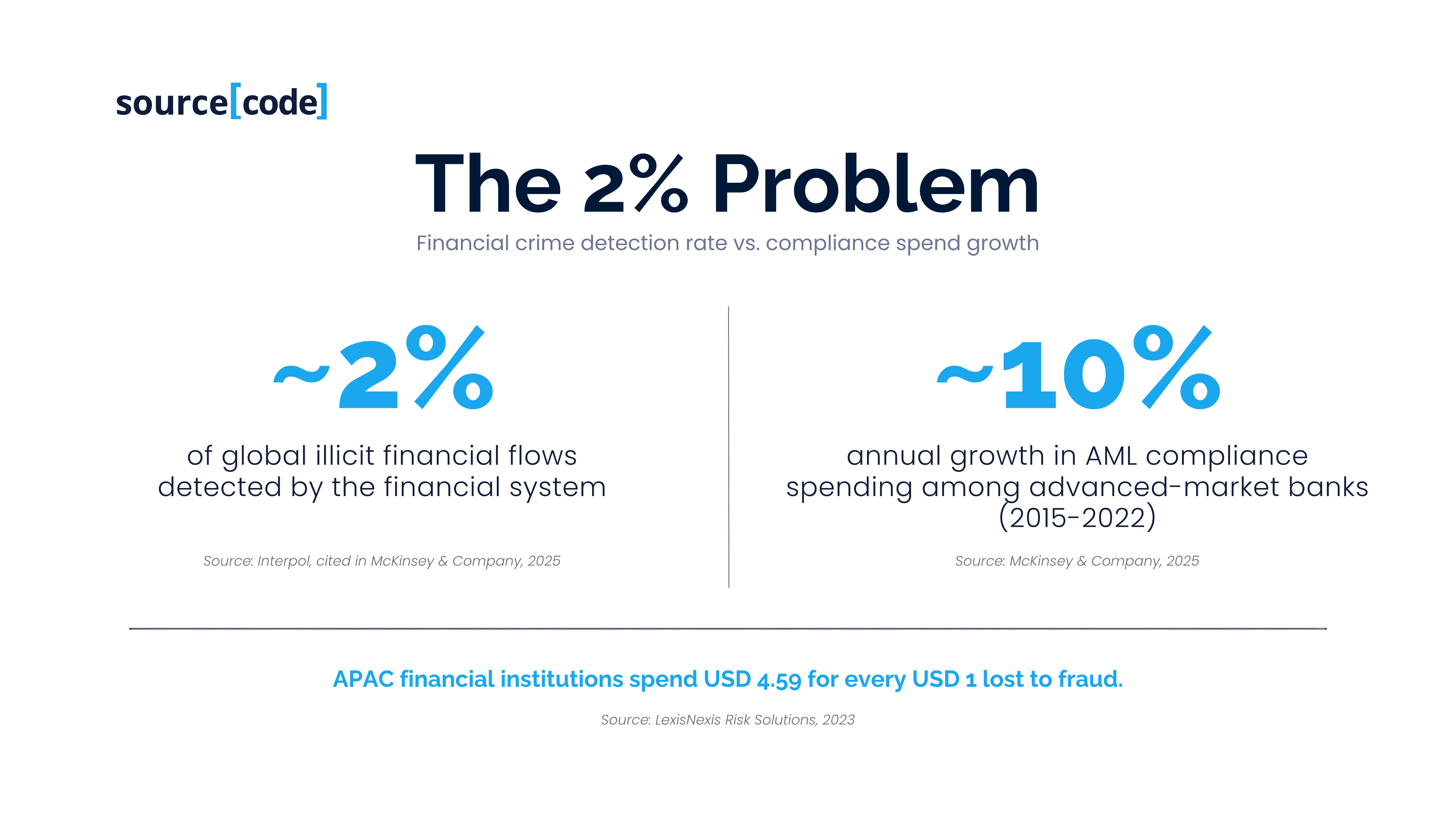
The response emerging from Australia, Singapore and Hong Kong is not another rules upgrade. It is a re-architecture of financial crime compliance as an intelligence platform, powered by agentic AI, graph analytics and shared-signal utilities such as Singapore's COSMIC. For CIOs, CROs and Chief Data Officers, the shift is strategic: financial crime programs are becoming a data-and-engineering discipline that either becomes a source of resilience and cost recovery, or a permanent tax on shareholder returns.
Introduction
For twenty years, most APAC banks approached AML and KYC as a regulatory obligation to be met through headcounts, rulebooks, and periodic remediation. That model is exhausting. Transaction volumes have overtaken the reviewer; digital onboarding has overtaken batch KYC, and criminals - increasingly aided by generative AI - have overtaken the static rule.
Three forces are compressing at once. Regulators are raising the bar on demonstrable effectiveness. Illicit actors are industrializing deepfakes, synthetic identity fraud, and mule networks. And boards are asking why compliance costs continue to compound while suspicious matter reporting quality plateaus. The result is a rare alignment of regulatory, operational and financial incentives that makes the current window the most important AML/KYC modernization cycle in a generation.
This article examines what is changing, why the traditional stack is failing, which architectures are winning, and what practical steps senior technology leaders in banking, insurance and fintech should take now.
Industry Context: Why the 2% Problem Persists
Financial crime compliance in APAC is a paradox. Spend keeps rising, yet detection efficacy remains stubbornly low. Three structural issues explain the gap.
Fragmented data. Customer data, transaction data, device and behavioral signals live across dozens of source systems - core banking, cards, payments, wealth, treasury, and increasingly digital wallets. Most banks still integrate these through nightly batches into a monolithic transaction monitoring system, losing the temporal and relational context criminals exploit.
Rules that decay faster than they are written. Rule-based transaction monitoring produces false positive rates that industry benchmarks typically place between 90% and 98%. Analysts spend the majority of their time clearing noise rather than investigating substance. Meanwhile, adversaries adapt tactics - new corridors, layered accounts, mule-as-a-service marketplaces - faster than change control allows.
Compliance as a cost center. Financial crime programs can account for as much as 5% of total banking costs (McKinsey & Company, 2025). Because the function has been operated as a control rather than as an intelligence capability, most investments compound headcount instead of insight.
Compounding these operational realities is a regulatory environment that is finally converging around outcomes rather than paperwork. Australia's Anti-Money Laundering and Counter-Terrorism Financing Amendment Act 2024 passed Parliament on 29 November 2024, with Tranche 2 obligations extending the regime to lawyers, accountants, real estate, precious stones dealers and trust and company service providers from 1 July 2026 (Norton Rose Fulbright, 2025; Australian Government Department of Home Affairs, 2025). AUSTRAC has been explicit that the reforms modernize the treatment of digital currency and payments technology and expect "ongoing monitoring" and "demonstrable effectiveness" - language that translates into engineering requirements, not policy language.
In Singapore, the Collaborative Sharing of ML/TF Information & Cases (COSMIC) platform, operated by the Monetary Authority of Singapore in partnership with DBS, OCBC, UOB, Standard Chartered, Citibank and HSBC, has been live since 1 April 2024, allowing regulated banks to share information on customers exhibiting multiple red flags across three focus areas: misuse of legal persons, misuse of trade finance and proliferation financing (Monetary Authority of Singapore, 2024). In May 2026, FATF's mutual evaluation confirmed the robustness of Singapore's framework (Monetary Authority of Singapore, 2026), while a July 2025 enforcement action imposed S$27.45 million in penalties on nine institutions linked to the S$3 billion money laundering case (Monetary Authority of Singapore, 2025). Hong Kong's HKMA and SFC are elevating fraud prevention, AML/CTF compliance and virtual asset supervision as 2026 priorities (Clifford Chance, 2026).
Across all three jurisdictions, the message is the same: regulators are moving from process compliance to intelligence outcomes.
Current Challenges: Where Legacy Stacks Break
Executives typically inherit a financial crime stack built through acquisition and expedience. Five pain points recur.
The first is the onboarding-to-monitoring seam. KYC data captured at onboarding rarely refreshes automatically. Perpetual KYC - continuous re-verification based on triggers rather than calendar cycles - remains aspirational at most APAC banks despite years of investment.
The second is entity resolution. Without a reliable enterprise view of the customer and their beneficial ownership network, transaction monitoring is scoring accounts rather than actors. Criminals rely on this blind spot.
The third is alert triage economics. When 95 of every 100 alerts are false positives, the marginal cost of a new detection rule is negative: it consumes more investigator time than it prevents loss. Most banks quietly stop adding rules for this reason, freezing detection at yesterday's typologies.
The fourth is model risk governance. AI-augmented detection introduces explainability, drift and bias risks that Chief Risk Officers must be able to defend to APRA, MAS, HKMA and boards. Many institutions still lack a model inventory, lineage catalogue and audit-grade evidence pipeline for compliance models.
The fifth is fragmented case management. Investigators toggle between systems for KYC, transaction monitoring, sanctions, adverse media and internal referrals. Regulators increasingly ask for a single audit trail; most banks cannot produce one without manual reconstruction.
Key Trends: The Emerging Financial Crime Intelligence Stack
Four architectural shifts are separating the leaders from the laggards.
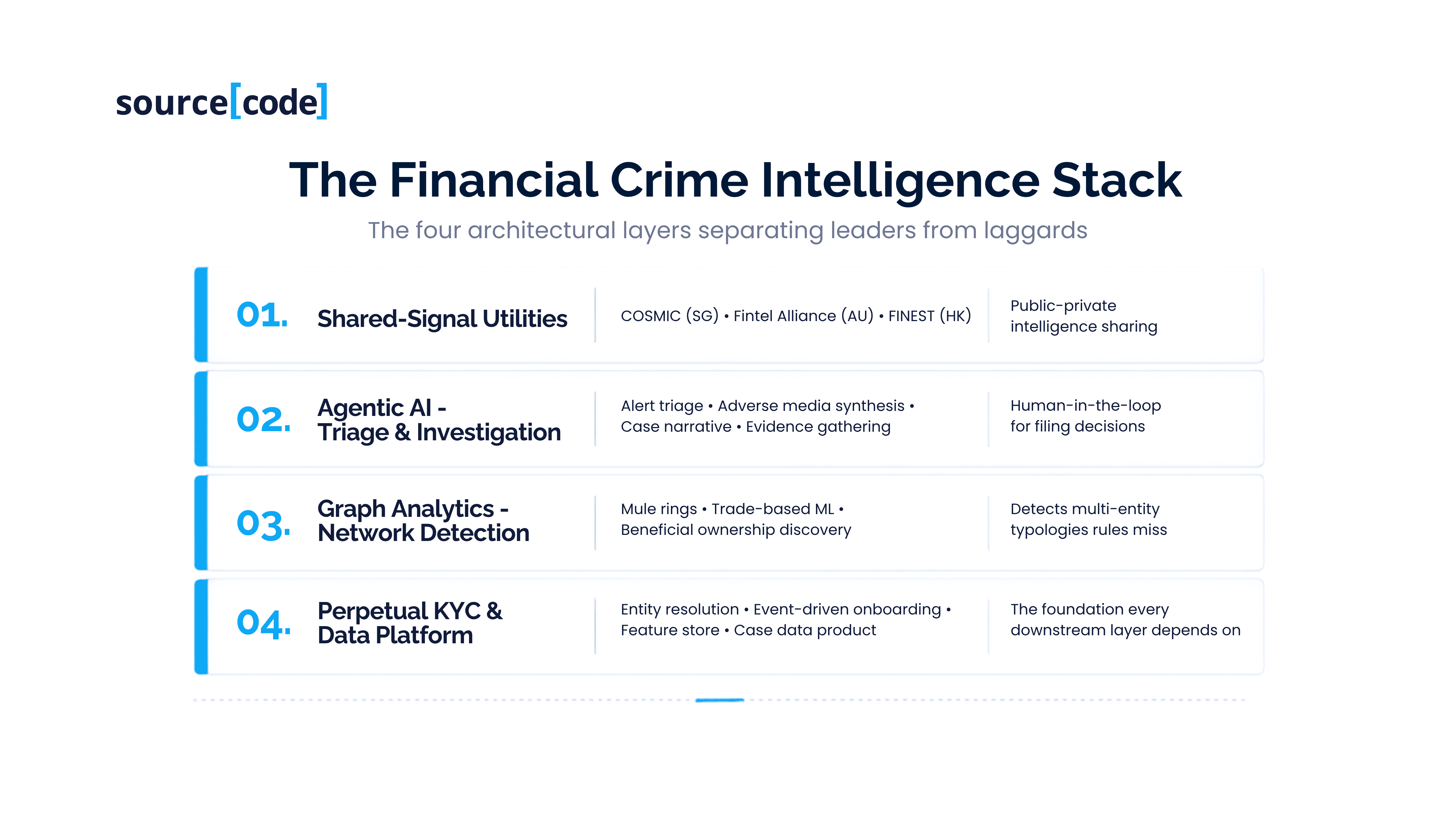
1. Agentic AI as a triage and investigation layer
McKinsey's 2025 analysis argues that agentic AI - orchestrated large language models with tool access and memory - can automate significant portions of the KYC and AML lifecycle end-to-end, materially improving auditability and detection while reducing manual effort (McKinsey & Company, 2025). Applied selectively, AI-augmented AML systems can lift the identification of suspicious activities by up to 40% versus rules-only baselines while sharply reducing false positives (McKinsey & Company, 2025). BCG's parallel work on KYC suggests the target economic model is a 30-50% reduction in unit cost of compliance while improving effectiveness (BCG, 2025).
Yet BCG's broader 2025 banking research finds that only 25% of institutions have integrated AI into their strategic playbook; the remaining 75% are stuck in disconnected pilots (BCG, 2025). The gap between what leaders demonstrate and what most institutions have deployed is the largest single opportunity in the compliance stack today.
2. Graph analytics for network-level detection
Financial crime is a network phenomenon. Transactional graphs - connecting customers, accounts, devices, counterparties and beneficiaries - allow banks to detect multi-entity layering, mule rings and coordinated typologies that no single-account rule can see. Graph-based detection reduces false positives while catching complex typologies that rules and traditional supervised models miss, particularly when combined with community detection and network anomaly scoring (EY, 2024). For APAC banks whose customer base extends across cross-border corridors, graph is no longer an experiment.
3. Shared-signal utilities and public-private intelligence
Singapore's COSMIC is the most advanced example of regulated intelligence-sharing between banks; Australia's Fintel Alliance operates as a public-private partnership between AUSTRAC and industry; Hong Kong's Financial Intelligence Evaluation Sharing Tool (FINEST) enables similar collaboration. The direction of travel is clear: regulators expect banks to combine internal signals with sector-level intelligence. This has material engineering implications - banks need trusted data-sharing pipelines, consent-managed identity resolution, and privacy-preserving techniques such as federated learning and confidential computing.
4. Perpetual KYC and event-driven onboarding
The regulatory shift from periodic reviews to ongoing monitoring is turning KYC from a batch process into a stream. Event-driven architectures, feature stores, and continuous risk scoring at the customer level are becoming the default target state. Institutions that have modernized their data platform can retire the annual "refresh" project and move to continuous, evidence-based due diligence - a far more defensible posture under Australia's revised effectiveness standard.
Strategic Analysis: The Real Prize Is Not Cost Reduction
Most business cases for financial crime modernization lead with cost. That is the wrong anchor.
The greater strategic value lies in three second-order effects. First, customer experience: friction reduction at onboarding and reduced false-positive freezes are measurable drivers of activation and retention, particularly for digital-native segments where a single blocked transaction can lose a customer. Second, strategic optionality: a modern AML/KYC platform is a prerequisite for embedded finance, cross-border payments, virtual asset services and merchant enablement. Institutions without it will not be able to underwrite the next generation of revenue models at a compliant cost base. Third, regulatory capital of trust: banks that can demonstrate effective, evidenced financial crime programs will earn latitude with regulators to move faster in adjacent areas, from open banking to tokenized settlement.
The equation for boards is therefore not "how much can we save?" It is "what growth are we currently unable to underwrite because compliance cannot scale?"
Real-World Examples
- Singapore's COSMIC network demonstrates that regulated intelligence-sharing between competitors is feasible when the platform is architected around consent, minimal disclosure and controlled typologies. Its 2024 launch across six major banks establishes a template other jurisdictions are studying (Monetary Authority of Singapore, 2024).
- Australia's Fintel Alliance, established in 2017 and continually expanded, has produced disruptive intelligence outcomes in child exploitation financing and human trafficking that would not have been achievable through single-bank monitoring - a proof point that shared signal beats siloed spend (AUSTRAC, 2024).
- Global tier-1 banks deploying graph-based detection have reported false positive reductions of 30-60% in transaction monitoring pilots, with a parallel uplift in high-quality alert conversion, according to industry practitioner reports (EY, 2024).
- HKMA's AML/CFT RegTech adoption practice guide has been referenced by supervisors as a maturity yardstick, with senior management effectiveness the differentiator between successful adopters and stalled programs (Hong Kong Monetary Authority, 2024).
Actionable Recommendations for CIOs, CROs and CDOs
The transformation is achievable, but the sequencing matters. We recommend a twelve-to-eighteen-month program built on five moves.
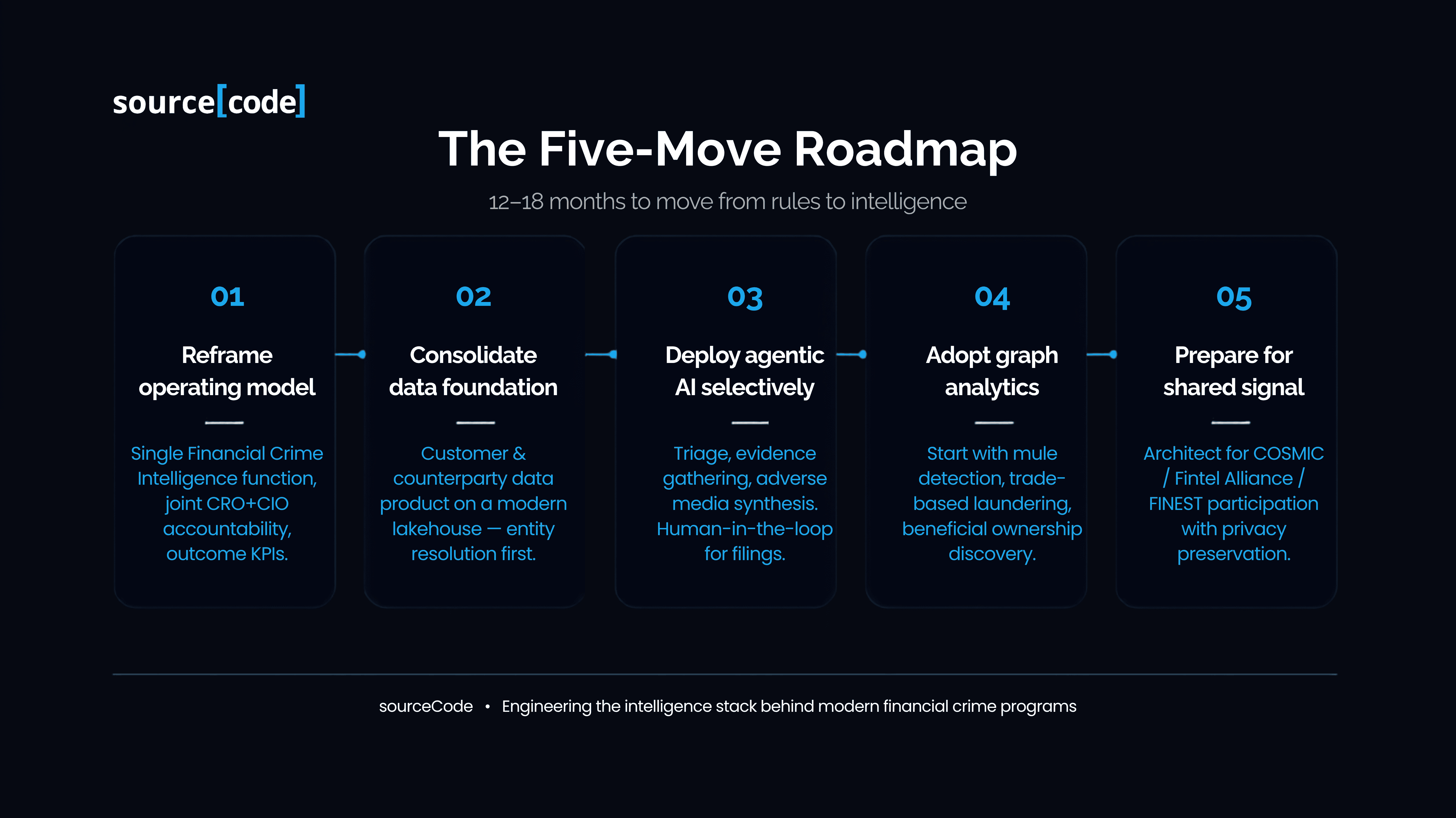
1. Reframe the operating model around intelligence, not process. Establish a single accountable Financial Crime Intelligence function reporting jointly to the CRO and CIO. Set outcome KPIs - quality-adjusted SAR rate, network-level detections, alert conversion - rather than volume KPIs.
2. Consolidate the data foundation. Build a customer- and counterparty-centric data product on a modern lakehouse, with entity resolution, beneficial ownership graph, transaction stream and case data as first-class assets. This is the platform every downstream initiative depends on.
3. Deploy agentic AI selectively where auditability is provable. Prioritize triage, evidence gathering, adverse media summarization and case narrative generation. Retain human-in-the-loop for filing decisions. Instrument every model with lineage, drift, bias and explainability metrics from day one.
4. Adopt graph analytics for network typologies. Start with mule detection, trade-based money laundering and beneficial ownership discovery - the three typologies where network context most changes the answer.
5. Prepare for shared-signal participation. Design your data platform so it can participate in COSMIC, Fintel Alliance, FINEST and successor utilities without bespoke integration effort. Federated learning and privacy-preserving computation should be part of the reference architecture.
Each move produces measurable value within one quarter and compounds across the eighteen-month arc.
sourceCode Perspective
The failure mode we see most often is that AML and KYC modernization stalls not because the AI is immature, but because the underlying data and platform engineering are. Financial crime intelligence sits on top of the same fundamentals that determine core banking modernization, payments resilience and AI-native delivery - a well-governed data platform, event-driven integration, high-integrity engineering and disciplined MLOps.
sourceCode partners with APAC BFSI leaders across these fundamentals. Our engineering teams build and modernize the data platforms and lakehouses that make perpetual KYC possible; our integration practice re-plumbs the onboarding-to-monitoring seam so events flow in real time; our AI engineering group implements agentic workflows with the model governance and explainability that regulators expect; and our platform engineering practice provides the resilient, cloud-native foundation on which the whole intelligence stack runs. The through-line of our work is a consistent principle: financial crime programs succeed when they are engineered as products, not procured as tools.
Conclusion
The AML and KYC reset underway across APAC is not a compliance upgrade. It is the point at which financial crime programs stop being an operating cost and start being an intelligence capability - one that shapes what a bank can safely offer, at what unit cost, in which corridors. The regulators know this. The best-funded criminals know this. The banks that translate the shift into a coherent platform and engineering program will find the compliance function transformed from a headwind into a source of competitive advantage.
The 2% detection problem is not solved by more analysts. It is solved by the right data, the right architecture, and the right operating model - deployed with the discipline that only engineering-led transformation delivers.
Exploring how to move your AML and KYC platform from rules to intelligence? Talk with sourceCode about the data, platform and AI engineering foundations behind a modern financial crime program.
Frequently Asked Questions
What is driving APAC banks to modernize AML and KYC platforms in 2026? A convergence of regulatory reform (Australia's AML/CTF Amendment Act 2024, MAS enforcement, HKMA priorities), sharply rising enforcement penalties, agentic AI maturity, and evidence that legacy rules-based detection captures only about 2% of illicit flows.
What is agentic AI in financial crime compliance? Agentic AI refers to orchestrated large language models with tool access, memory and the ability to execute multi-step workflows. In AML and KYC, it can automate alert triage, evidence gathering, adverse media synthesis and case narrative generation, while keeping filing decisions with human investigators.
What is COSMIC? COSMIC (Collaborative Sharing of ML/TF Information & Cases) is a Singapore MAS-operated digital platform launched on 1 April 2024, enabling six major banks to share information on customers exhibiting multiple financial crime red flags across three typologies: misuse of legal persons, trade finance misuse and proliferation financing.
How large is the financial crime compliance cost problem? McKinsey estimates financial crime compliance can consume up to 5% of total banking costs. APAC financial institutions spend approximately USD 4.59 for every USD 1 lost to fraud (LexisNexis Risk Solutions, 2023).
Where should CIOs start? Data platform consolidation and entity resolution first, then selective agentic AI in triage and evidence gathering, then graph analytics for network typologies, and finally participation in shared-signal utilities.
References
Australian Government Department of Home Affairs. (2025). Overview of the AML/CTF Amendment Act. Available at: https://www.homeaffairs.gov.au/criminal-justice/Pages/overview-of-the-amlctf-amendment-act.aspx
AUSTRAC. (2024). Fintel Alliance. Available at: https://www.austrac.gov.au/business/how-comply-guidance-and-resources/fintel-alliance
BCG. (2025). For Banks, the AI Reckoning Has Arrived. Available at: https://www.bcg.com/publications/2025/for-banks-the-ai-reckoning-has-arrived
BCG. (2025). The Know-Your-Customer Agentic AI Revolution. Available at: https://www.bcg.com/publications/2025/know-your-customer-agentic-ai-revolution
Clifford Chance. (2026). Financial Crime Enforcement: Key Issues to Watch in Hong Kong in 2026. Available at: https://www.cliffordchance.com/content/dam/cliffordchance/Thought_Leadership/financial-crime-enforcement-key-issues-to-watch-in-hong-kong-in-2026.pdf
EY. (2024). How graphs and AI are shaping the future of financial crime prevention. Available at: https://www.ey.com/en_se/insights/financial-services/how-graphs-and-ai-are-shaping-the-future-of-financial-crime-prevention
Hong Kong Monetary Authority. (2024). AML/CFT Regtech Adoption Practice Guide. Available at: https://www.hkma.gov.hk/eng/regulatory-resources/regulatory-guides/by-subject-current-topical-issues/anti-money-laundering-and-counter-financing-of-terrorism/
LexisNexis Risk Solutions. (2023). True Cost of Financial Crime Compliance Study - APAC. Available at: https://risk.lexisnexis.com/global/en/insights-resources/research/true-cost-of-financial-crime-compliance-study-apac
LexisNexis Risk Solutions. (2024). APAC AML enforcement snapshot. Available at: https://risk.lexisnexis.com/global/en/insights-resources
McKinsey & Company. (2025). How agentic AI can change the way banks fight financial crime. Available at: https://www.mckinsey.com/capabilities/risk-and-resilience/our-insights/how-agentic-ai-can-change-the-way-banks-fight-financial-crime
Monetary Authority of Singapore. (2024). COSMIC: Collaborative Sharing of ML/TF Information & Cases. Available at: https://www.mas.gov.sg/regulation/anti-money-laundering/cosmic
Monetary Authority of Singapore. (2025). MAS imposes composition penalties on nine financial institutions. Available at: https://www.mas.gov.sg/news
Monetary Authority of Singapore. (2026). Singapore has a robust framework for combatting financial crime according to international body. Available at: https://www.mas.gov.sg/news/media-releases/2026/singapore-has-a-robust-framework-for-combatting-financial-crime-according-to-international-body
Norton Rose Fulbright. (2025). Australia's AML/CTF Reforms: A New Era in Financial Crime Prevention. Available at: https://www.nortonrosefulbright.com/en/knowledge/publications/4bdd08b3/australia-amlctf-reforms-a-new-era-in-financial-crime-prevention